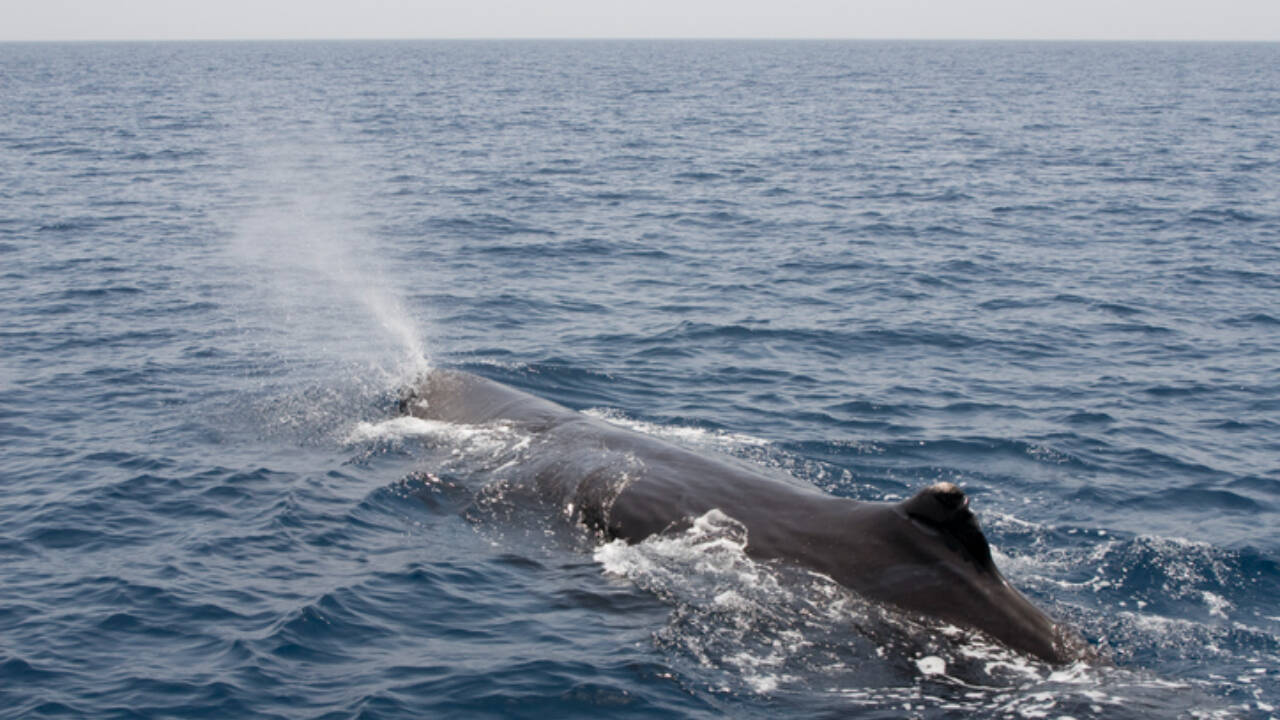
If you happened to swim through the cold waters off Norway's Lofoten Islands, you might stumble upon a scene that looks completely uncanny. Dozens of massive sperm whales hang perfectly upright in the water column like giant, dark monoliths. They don't move a muscle. They don't splash. They just float vertically, heads pointing toward the sky, suspended just beneath the surface.
For years, marine biologists knew these giant ocean mammals slept vertically, but nobody could figure out the physics behind it. How does an animal weighing up to 45 tons stay perfectly still without floating up like a cork or sinking into the abyss?
A team of scientists from the University of St Andrews and Université de Neuchâtel attached high-tech suction-cup tags to 42 sperm whales in the Arctic Circle to solve the mystery. Published in the Journal of Experimental Biology, their research shows that sleeping whales vent precise bursts of gas bubbles to fine-tune their buoyancy while asleep.
It turns out these oceanic giants are essentially operating like underwater submarines while taking a power nap.
Why Sperm Whales Sleep Upright in the First Place
Sleeping in the ocean is a logistical nightmare for air-breathing mammals. Land animals can collapse on the ground and zone out completely, but whales don't have that luxury. If a whale falls into a deep, unconscious sleep, it drowns.
Because of this, sperm whales practice what scientists call unihemispheric sleep. They shut down one half of their brain at a time, keeping the other half awake enough to monitor their environment and manage breathing.
Hanging vertically just a few meters below the waves gives them two major advantages.
First, it protects them from choppy surface waves that would constantly beat against them and interrupt their rest. Second, staying close to the surface saves massive amounts of energy. Diving deep requires effort, and floating upright near the top lets them catch quick 10 to 30 minute naps before surfacing for air.
The catch is physics.
The Physics Problem of Sleeping Underwater
Whales are loaded with buoyant materials. A sperm whale's huge head contains vast reservoirs of low-density spermaceti oil and lipids. On top of that, their lungs contain air from their last breath.
As scuba divers know all too well, gas expands as ambient pressure drops near the surface. If a whale relaxes near the surface, the air trapped inside its lungs gradually expands as it drifts upward even a tiny bit. That expansion increases positive buoyancy. Left unchecked, the whale would involuntarily float to the surface like a runaway party balloon.
To stay suspended, the whale needs neutral buoyancy—a state where it neither rises nor sinks.
That's where the gas venting comes in.
How Whales Toot Gas to Control Their Depth
Professor Patrick Miller and his research team tracked 42 individual whales using non-invasive suction cup tags capable of recording 3D movement and underwater sound. The acoustic recordings picked up distinct, sharp popping sounds.
Those sounds were gas bubbles escaping from the whales' blowholes.
When the researchers plugged the movement data and tissue densities into computer simulations, the math matched up instantly. Every time a resting whale started drifting upward due to expanding lung air, it released a calculated burst of bubbles. Releasing that small volume of gas reduced the animal's positive buoyancy, dropping it right back into a steady, neutral position in the water column.
The frequency of these bubble releases depends entirely on how deep the whale starts its nap.
When whales start resting right near the surface, they release gas frequently—up to 11 times per resting dive. Near the surface, water pressure is lower, so lung gas expands quickly and requires constant adjustment.
When whales transition into a nap after returning from deep foraging dives past 100 meters, they barely release any bubbles at all—sometimes only three or four times. Down deep, the immense water pressure compresses the air inside their lungs, making the gas far less buoyant to begin with.
Automatic Micro-Adjustments While Half Asleep
What makes this discovery mind-boggling is that the whales do all of this while half-asleep.
Human divers have to consciously adjust their buoyancy compensators to stay level underwater. Sperm whales manage the same delicate balance through subconscious micro-adjustments. Their nervous system detects subtle pressure changes and vents exact volumes of air through their blowholes without waking them up completely.
Researchers suspect there might be another reason for these bubble releases too.
When whales spend long periods holding their breath, metabolic waste gases like carbon dioxide and nitrogen build up in their body tissues. Releasing bubbles during rest periods might help flush excess CO2 or nitrogen out of their system before their next deep dive.
How to Apply These Insights
If you work in marine biology, underwater robotics, or biomechanics, this discovery offers practical takeaways for designing autonomous underwater systems.
- Study biological buoyancy control: Marine engineers working on autonomous underwater vehicles (AUVs) can mirror this mechanism. Using micro-venting systems rather than continuous thrusters saves massive amounts of battery power during stationary monitoring tasks.
- Support non-invasive tagging research: The suction-cup tag technology used in this study shows how much we can learn about ocean giants without harming them or disrupting their natural behaviors.
- Follow ongoing bio-acoustic research: Keep an eye on updates from the Sea Mammal Research Unit at the University of St Andrews as they continue analyzing whale acoustic data to better understand marine mammal sleep patterns.