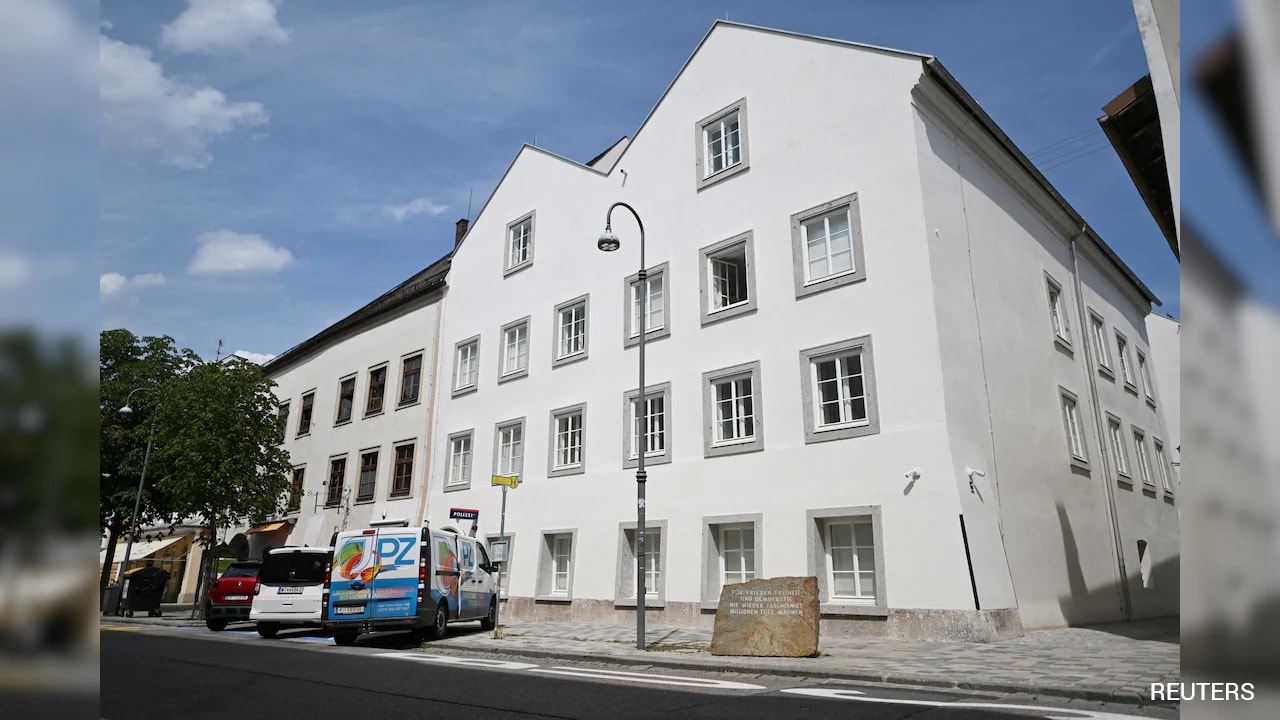
If you walk down Salzburger Vorstadt in the quiet Austrian border town of Braunau am Inn, you might notice a stark white, three-story building that looks surprisingly ordinary. There are no grand plaques extolling its heritage. There are no dramatic architectural flourishes. Outside, a humble granite block shipped from the Mauthausen concentration camp bears a stark inscription warning against fascism. Above the main entrance, a simple blue sign reads Police.
This unassuming building is where Adolf Hitler was born on April 20, 1889. For a deeper dive into similar topics, we suggest: this related article.
After decades of bitter legal battles, public arguments, and intense political anxiety, Austria has officially transformed the former dictator's birthplace into a functioning police station. The government spent roughly €20 million ($23 million) to strip the site of its historical features, whitewash its facade, and move law enforcement officers right into the space where the Nazi leader spent the first few weeks of his life.
The official line from Vienna is straightforward. Officials want to neutralize the building. They want to break its magnetic pull for far-right extremists who have spent years treating the address as an unholy pilgrimage site. But does putting a squad of narcotics officers inside a building actually erase the dark shadow hanging over it? Or is it just a high-priced attempt to sweep uncomfortable history under the rug? For broader information on this topic, extensive analysis is available at USA Today.
Honestly, the reality is far more complicated than a whitewashed wall.
The Long Battle Over a 17th Century House in Braunau
To understand how a local police station ended up in Hitler's birth house, you have to look at how awkward this property has been for Austria over the last century.
Hitler didn't actually live in the house at Salzburger Vorstadt 15 for very long. His father, Alois Hitler, was a customs official stationed along the Bavarian border, and the family rented an apartment on the upper floor. Within a few weeks or months, the family packed up and moved elsewhere in town before leaving Braunau altogether when Adolf was three.
That brief stay didn't stop Nazi propagandists from turning the building into a shrine during the Third Reich. Under Nazi rule, the structure was bought by the party and turned into a cultural center and art gallery.
After World War II, ownership reverted back to the original local family, the Pommers. For decades, the Austrian Interior Ministry paid a hefty monthly rent to the property's private owner, Gerlinde Pommer, simply to maintain full control over who used it. Over the years, the building served as a bank, a school, and later a day center for adults with disabilities run by a local charity.
Then things fell apart.
In 2011, Pommer refused to allow necessary renovations to make the building wheelchair-accessible. She also rejected all government offers to buy the property outright. The building sat completely empty for years, falling into disrepair while neo-Nazis, skinheads, and curious tourists kept showing up. Extremists posed outside making illegal Nazi salutes, laid flowers on Hitler's birthday, and even chipped off pieces of stone to take home as souvenirs.
By 2016, the Austrian government had enough. Parliament passed a custom expropriation law to seize the property from Pommer. After a prolonged legal fight over compensation, the Austrian Supreme Court awarded her €812,000 in 2019. Finally, the state had total control. The big question was: what on earth should they do with it?
A Twenty Million Euro Redesign to Neutralize a Symbol
Some people wanted the building bulldozed. Tear it down, crush the bricks, and plant a park.
Historians and architects immediately pushed back against demolition. Destroying the house would look like Austria was trying to deny its own past, playing into the old myth that Austria was merely "the first victim" of Nazism rather than an active participant. Besides, the structure dates back to the 17th century and sits within a protected historic town center.
Instead, the government launched an international architecture competition to redesign the space. The winning proposal, created by the Austrian firm Marte.Marte Architekten, focused on total visual neutralization.
Look at what they actually changed:
- The striking ochre-yellow paint that made the house instantly recognizable in photographs was scrubbed away and replaced with plain white.
- Prominent historic arches on the ground floor were replaced with standard rectangular windows.
- The roofline and facade were extended upward to align visually with surrounding townhouses, blending it into the row.
- Workers secretly hauled away construction rubble to undisclosed locations so no extremist could steal a piece of concrete to trade on underground forums.
The result is a building designed to be as visually boring as possible. If you didn't know the address, you would walk right past it without giving it a second glance.
Why the Government Picked Law Enforcement
Deciding to put a police station inside the building wasn't a random administrative decision. It came directly from recommendations made by an expert commission tasked with finding a long-term solution.
The logic was simple. An open public space like a museum, a cultural center, or a refugee facility would still attract visitors. A museum, in particular, risked becoming an unintended focal point for right-wing extremists seeking to glorify the site.
By moving police officers into the building—specifically a specialized regional unit handling narcotics trafficking along the German border—the government accomplished two things at once:
First, police officers are physical guardians of constitutional democracy and public safety. Placing law enforcement inside Hitler's birthplace is symbolic defiance. It replaces authoritarian tyranny with democratic authority.
Second, it puts round-the-clock security on site. Neo-Nazis aren't going to pull off a Hitler salute, snap a selfie, or lay roses on the doorstep when there are armed officers and high-definition security cameras right above their heads.
Austrian Interior Minister Gerhard Karner made that stance clear at the opening ceremony, stating that the address is now a "place of democracy, the rule of law, security, freedom, and human dignity."
The Counterargument That Austria Is Trying to Erase Its Past
Not everyone is applauding this €20 million makeover. In fact, the project faces harsh criticism from Holocaust survivor advocates and historians.
Robert Eiter, a spokesman for the Mauthausen Committee—Austria’s primary Holocaust survivors' organization—has been vocal about his disapproval. He argues that trying to "neutralize" the building is a misguided attempt to encourage collective amnesia.
"The world won't forget where the worst mass murderer in history was born," Eiter pointed out. "Wikipedia won't change its entries. And this renovation will not prevent a single neo-Nazi from making the pilgrimage to Braunau."
Critics argue that by removing historical markers from the building itself and turning it into an administrative police hub, Austria is missing an opportunity to educate the public about state-sponsored hatred. Historian Florian Kotanko noted that attempting to remove the building's recognition factor is practically impossible in the digital age, where every smartphone map app points directly to the coordinates.
Some local residents in Braunau also voiced disappointment. Many locals preferred the building's previous life as a care center for people with disabilities. That function served as a quiet, powerful living counter-narrative to the Nazi regime's horrific Aktion T4 eugenics program, which murdered tens of thousands of disabled individuals.
What Really Happens Now at Salzburger Vorstadt 15
Now that the ribbon has been cut and the officers have moved in, what changes for the average person?
If you visit Braunau today, you won't find a tour guide or an exhibition inside. The interior is restricted to police personnel and official business.
The only remaining explicit reminder on the street is the memorial stone on the public sidewalk outside, which was carved from granite extracted from the quarry at the Mauthausen concentration camp back in 1989. Its message remains unchanged:
"For peace, freedom and democracy. Never again fascism. Millions of dead warn."
Austria’s strategy here isn't about pretending Adolf Hitler didn't exist. It's about denying modern fascists a physical platform to celebrate him. Whether a redesigned facade and a team of police officers will permanently curb extremist curiosity remains to be seen. But for the town of Braunau am Inn, turning a symbol of hatred into a routine office for civil public service is the most practical step forward available.
Actionable Takeaways for History and Heritage Travelers
If you are planning to visit historic World War II memorial sites in Austria or Southern Germany, keep these practical points in mind:
- Respect local laws strictly: Austria maintains very tough anti-Nazi laws (Verbotsgesetz). Displaying Nazi symbols, making straight-armed salutes, or wearing extremist paraphernalia carries severe criminal penalties, including immediate arrest and mandatory prison sentences.
- Skip the Braunau photo-op: Braunau am Inn is a charming historic town, but photographing the police station facade with sensitive gestures will draw immediate law enforcement intervention.
- Visit dedicated educational memorials instead: For genuine historical context and education regarding WWII and the Holocaust in Austria, visit established educational sites like the Mauthausen Concentration Camp Memorial near Linz or the House of Austrian History (Haus der Geschichte Österreich) in Vienna.