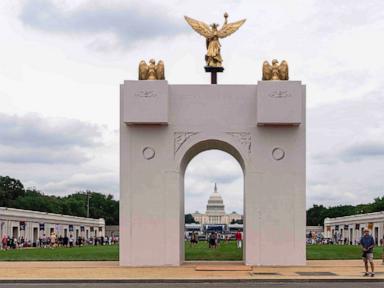
You can't just drop a 250-foot monumental structure into the nation's capital without a massive fight. President Donald Trump's plans for a towering triumphal arch near Memorial Bridge have officially cleared a major hurdle, with a fresh National Park Service report backing the location despite acknowledging obvious damage to historic Washington sightlines.
If you've been following urban planning or federal architecture debates, you know that Washington's landscape isn't an accident. Every monument, every avenue, and every open vista has been meticulously engineered over generations. So when a federal report admits a massive project alters the visual and spatial integrity of dozens of historic properties, people get upset.
Let's look at what's actually happening on the ground and why this project is stirring up so much controversy.
The Sightline Problem Everyone is Arguing About
Washington DC is built on visual connections. The alignment between the Lincoln Memorial, Memorial Bridge, and Arlington House—formerly the home of Robert E. Lee—was originally designed to physically and symbolically unite North and South across the Potomac River.
The new 133-page National Park Service report lays it out plainly. The 250-foot arch will break this alignment. It alters character-defining relationships between iconic landmarks, touching properties like:
- The Lincoln Memorial and the Washington Monument
- The Jefferson Memorial and the U.S. Capitol
- The Georgetown Historic District and the Old Naval Observatory
- Key Bridge and the National Cathedral
Critics point out that these disruptions aren't minor tweaks. They alter the fundamental geometry of the National Mall.
Why the National Park Service Backed It Anyway
It sounds contradictory. Why would an agency dedicated to historic preservation endorse a project that explicitly harms historic preservation guidelines?
The answer lies in federal review logic. The Park Service report argues that the very characteristics making Memorial Circle sensitive for preservation also make it the only historically appropriate spot for this specific undertaking. Relocating the arch or shrinking it would defeat the entire purpose of the commemorative project.
In short, the agency basically concluded that if you're going to build a massive arch to leave an executive imprint, this is where it has to go, collateral damage included.
The Legal and Political Battles Ahead
Unsurprisingly, this hasn't gone down smoothly. Legal challenges are already mounting. Plaintiffs, including veterans and architectural historians represented by the Public Citizen Litigation Group, argue that a project of this magnitude requires congressional approval. They claim it shouldn't be rushed through via executive decree or fast-tracked by panels filled with presidential appointees, such as the U.S. Commission of Fine Arts.
Nicolas Sansone, an attorney representing the legal challengers, noted that the report confirms fears about how drastically the structure will transform the National Mall.
This arch is just one piece of a broader push by the administration to leave a physical legacy in D.C. Other initiatives include renovating the Kennedy Center, constructing a massive new White House ballroom, and redesigning parts of East Potomac golf course.
What Happens Next
The U.S. Capital-Area Planning Commission gave preliminary site approval during its summer meetings, but the fight is far from over. Expect more lawsuits, fierce preservationist pushback, and intense debates over executive authority versus congressional oversight as the project heads into its next review phases.
If you want to track how this plays out, watch the upcoming commission hearings this fall. The architectural face-off for the soul of Washington's skyline is just getting started.