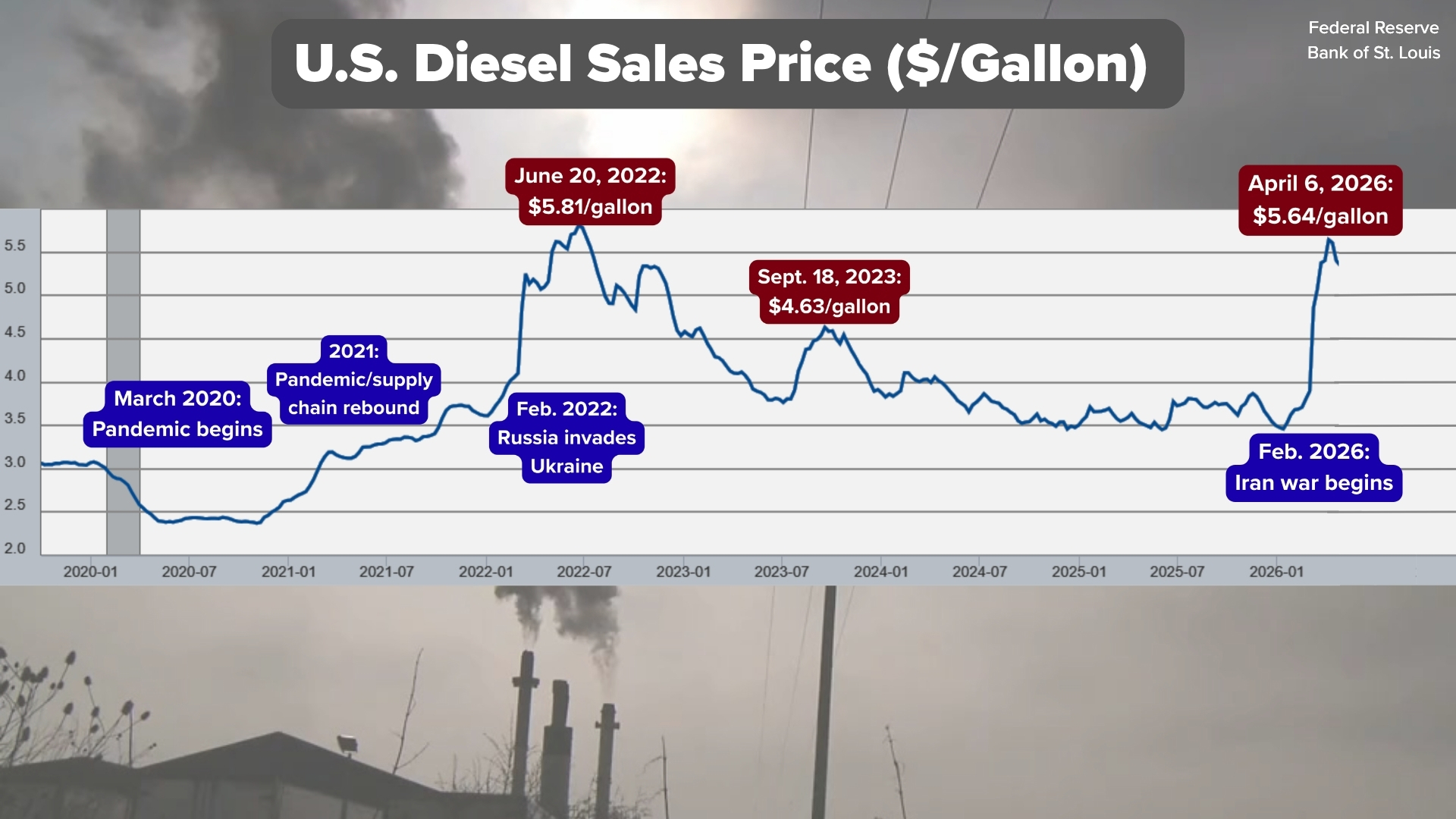
Most people pay attention to the price of gasoline. They see the digits climb on the glowing signs at the corner station and complain about their weekend road trip becoming expensive. But you should be looking at diesel. When diesel prices skyrocket, the entire machine that keeps the country fed, clothed, and sheltered starts to break.
We are currently seeing a massive jump in diesel costs in 2026, with prices hitting as high as $5.45 a gallon in some regions. This isn't just about the wallet-drain of a long-haul trucker. It is a fundamental disruption to the supply chain. When the cost of moving goods rises, every single thing you buy gets tagged with that extra expense.
Why Diesel Is The Real Inflation Engine
Gasoline is a consumer concern. Diesel is a business necessity. The economy runs on distillates. If you look at the logistics of how a loaf of bread reaches your local grocery store, it relies on diesel at every stage. It’s in the tractors harvesting the wheat, the trains carrying the grain, and the heavy-duty semi-trucks delivering the final product.
Unlike gasoline, which has some flexibility in terms of consumption, diesel demand is structurally sticky. You can’t stop shipping goods just because the price of fuel is high. This is why when diesel prices jump—driven by things like conflict in the Middle East and refinery shutdowns in Russia—the impact isn't just a slight drag on growth. It’s an immediate, aggressive push toward higher consumer prices.
Right now, inventories of distillate fuel oil are sitting at 20-year lows. We are currently about 11% below the five-year average for this time of year. That’s a dangerous cushion. When supply is that thin, even a small ripple in global oil production causes a massive surge at the pump.
The Invisible Tax On Your Daily Life
You might not notice the diesel price at the pump if you drive a sedan, but you are feeling it at the checkout counter. When trucking companies face a 54% increase in fuel costs, they have two options. They can either absorb the loss or pass the cost to the retailers. Most can’t absorb it forever. They add fuel surcharges. Then the wholesaler adds a markup to cover their transport costs. By the time that item reaches the shelf, you’re paying for the fuel spike twice over.
Think about the agriculture sector. Fertilizer is petroleum-based. The planting, the harvesting, and the final distribution all depend on diesel. A sustained increase here means you aren't just paying more for gas; you're paying significantly more for your grocery bill. This is a quiet tax that hits lower-income households the hardest.
What Fleet Operators Are Doing To Survive
If you manage a fleet, you already know the margin-crushing reality of 2026. Fuel has always been a top expense, but now it’s becoming a make-or-break survival metric. Some operators are trying to get creative.
- Investing in engine efficiency: Simple carbon buildup can kill your fuel economy. Cleaning up the engine isn't just maintenance; it’s a direct response to high fuel costs.
- Adopting new tech: Some firms are testing hydrogen-assisted combustion to squeeze more energy out of every gallon. Every percentage point of efficiency matters when the price is over $5 a gallon.
- Revisiting routes: Data-driven route optimization has moved from a "nice to have" to a core operational strategy. You’re burning money every minute that truck idles in traffic.
The Reality Of Energy Infrastructure
There is a misconception that we can just "switch" production to make more diesel. It doesn't work like that. A barrel of crude produces a fixed amount of products. Refineries have to prioritize. Because diesel has stricter sulfur content requirements—due to environmental regulations—it’s more expensive to refine than gasoline. It takes more energy and more complex machinery to pull it off.
When you hear about refinery shutdowns, know that they hit diesel harder than gasoline. We are seeing the result of decades of underinvestment in refining capacity, combined with a volatile global situation that keeps crude prices unpredictable.
Practical Steps For Small Businesses
If your business relies on freight, don't just wait for prices to drop. You need to act now to insulate your operations.
- Audit your freight contracts: Look for transparency in fuel surcharges. Are you paying market rate or an inflated estimate?
- Review your inventory cycles: If transport is going to be expensive, shipping smaller, frequent batches is a losing game. Look for ways to consolidate your supply orders.
- Check your equipment: If you own the trucks, stop ignoring the maintenance schedules. A poorly maintained diesel engine isn't just inefficient; it's a financial liability in a high-price environment.
- Talk to your customers: Be honest about the cost of delivery. Don’t hide price increases in fees that leave them confused. Explain that logistics costs are rising and keep the relationship focused on reliability.
The price of diesel isn't going to stabilize overnight. The geopolitical factors driving this are deep-seated and likely to persist. Stop hoping for a return to cheap energy and start building a business that can function when the price of transit stays high. It’s the only way to stay competitive.