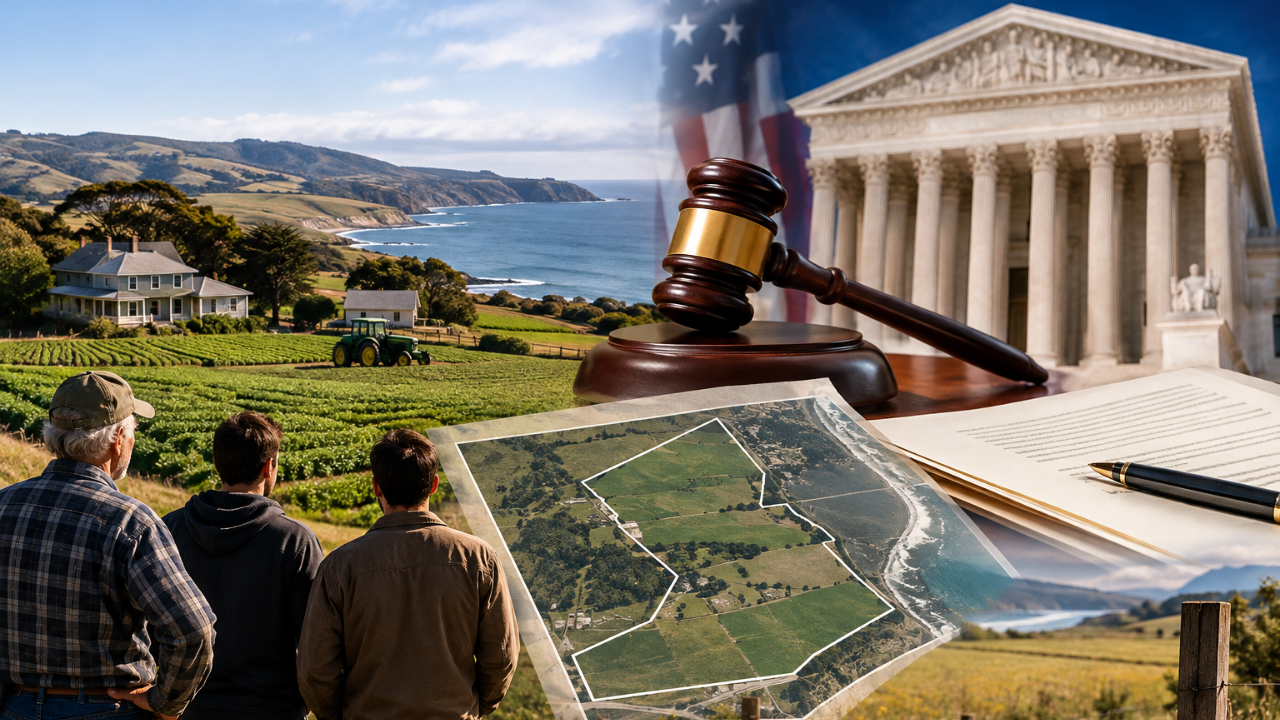
Land ownership in America supposedly comes with a bundle of inherent rights. You buy the acreage, you control the dirt, and you decide who sleeps under your roof. Right? Not quite. In places like Marin County, California, your deed comes with strings attached that stretch across decades.
A hard-fought legal war over a second home on a 267-acre coastal family property finally hit a brick wall when the United States Supreme Court declined to hear the appeal. For nine years, the Benedetti family tried to overturn a local rule tying residential expansion to mandatory commercial farming. Their defeat sets a sobering precedent for anyone who thinks owning rural land means you can build what you want for your kids.
Here is what actually happened, why the courts sided with local bureaucrats, and what this means for property rights moving forward.
The Roots of a Nine-Year Property Battle
The core of the dispute sits in Valley Ford, a quiet pocket of Marin County's coastal agricultural production zone. Willie Benedetti spent decades working that 267-acre spread, building agricultural operations and living on one of the property's parcels with his son Arron.
When Willie wanted to build another home on the land for his other son, Arthur, local rules threw up a massive roadblock. Marin County had updated its local coastal program and implementing ordinances. The new mandates permitted additional residential units on agricultural land only under strict conditions.
Specifically, the county required property owners to record a restrictive covenant that ran with the land. This meant whoever owned the new dwelling had to stay actively and directly engaged in commercial agriculture, either by farming it themselves or leasing it to a bona fide commercial producer.
Willie sued in July 2017. He passed away the following year, but his sons Arron and Arthur—who work as plumbers rather than commercial farmers—kept the litigation alive. They argued the county overstepped constitutional boundaries by forcing them to choose between farming a commercial scale or giving up family housing plans.
Constitutional Arguments and Lower Court Pushback
Represented by the Pacific Legal Foundation, the Benedettis leaned heavily on landmark Supreme Court cases like Nollan v. California Coastal Commission and Dolan v. City of Tigard. These rulings traditionally shield property owners from extortionate government conditions that lack a direct connection and rough proportionality to the impact of a proposed development.
The family pointed out a glaring mismatch. How did building a house for a family member on a 267-acre farm harm local agriculture to the point that the government could dictate their career choices or leasing requirements?
California courts didn't buy it. The Marin County Superior Court and the First District Court of Appeal ruled against the family. The appellate court decided in August 2025 that the covenant had a sufficient connection to the county's goal of preserving coastal farmland. The judges reasoned that tying new houses to active farming prevents residential values from pricing out agricultural uses. They also claimed the rule was proportionate because owners could meet the requirement through a commercial lease rather than picking up a tractor themselves.
When the family petitioned the nation's highest court in April 2026, hopes were high for a check on municipal overreach. Those hopes died on June 29, 2026, when the Supreme Court denied review without comment.
What This Means for Rural Landowners
The Supreme Court's refusal to take the case doesn't technically set a new nationwide constitutional rule, but its practical effect is devastating for rural property owners. It leaves local governments wide latitude to weaponize zoning codes as perpetual agricultural mandates.
If you own acreage in a regulated zone, you need to understand three harsh realities exposed by this case:
- Zoning follows the land forever. Covenants that run with the land do not expire when the original owner passes away. If you build under a conditional program, your heirs inherit those exact restrictions.
- Occupational freedom takes a backseat. Local agencies can legally pressure landowners into commercial farming operations or forced leasing arrangements just to secure family housing permits.
- The Supreme Court rarely rescues local land disputes. The justices routinely dodge municipal zoning battles, leaving landowners entirely at the mercy of state appellate courts and aggressive county planners.
Fighting City Hall takes deep pockets, specialized legal firepower, and nearly a decade of patience—often with zero guarantee of a fair hearing at the federal level. Before you buy rural property expecting to build extra homes for your children, check the local coastal or agricultural overlay ordinances line by line. Otherwise, you might find yourself trapped in a multi-year legal war that even the highest court in the land won't touch.