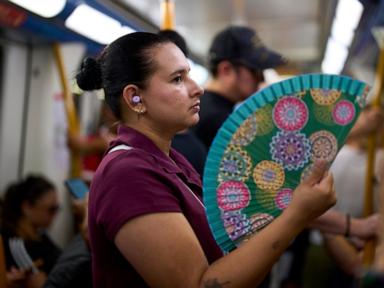
You step onto a crowded Madrid metro car in August and the air hits you like a wall. Temperatures hover near 39 degrees Celsius. Modern air conditioning strains against the onslaught. Yet, look around. Everyone is wielding a simple, brilliant piece of low-tech engineering: the traditional Spanish folding hand fan, or abanico.
We love to complicate things. When summer heat waves crush Western Europe, tech bros try to sell you heavy battery-powered pocket fans that buzz like angry hornets and die halfway through your commute. Spaniards choose differently. They rely on centuries of craftsmanship. The abanico snaps open with a single flick of the wrist. It generates an immediate, surprising gust of air without needing a USB charger.
The Resurgence of the Abanico
Walk down Puerta del Sol and you'll see twenty-somethings alongside senior citizens clutching these accessories. It's not just a quaint relic for tourists anymore. It's a functional survival tool.
Take 20-year-old Ana Feliu. She carries a large paper fan everywhere she goes during the summer months. She uses it both to catch a breeze and to block the punishing midday sun from her eyes. Or consider David González, a 53-year-old resident who sports an abanico splashed with bright pinks and purples. He admits he felt a bit self-conscious at first because society historically linked the item to women. Then common sense won out. The relief was too good to ignore.
Men across Spain are dropping their hang-ups. You see them unfolding colorful abanicos at packed soccer matches, music festivals, and political rallies.
History Etched in Wood and Silk
The folding hand fan didn't actually originate in Spain. Historians trace its arrival back to the 15th and 16th centuries via Portuguese maritime trade routes with Asia. But Spain made it entirely its own.
By the 17th century, master painters like Diego Velázquez immortalized the accessory in works like The Lady with a Fan. Fast forward to the 1800s, and the abanico became a complex social tool. The aristocracy used a secret "language of the fan." Opening it slowly, hiding your face, or tapping it against your hand communicated everything from flirtation to outright dismissal without uttering a single word.
Later, the fan found a home in flamenco. Dancers incorporated the prop to mirror the heavy, humid atmosphere imported from Cuban dance styles like the guajira. The prop added drama, movement, and a layer of provocative coquetry that defined the art form.
From Family Workshops to Street Kiosks
If you want a truly authentic piece, you head to places like Casa de Diego. This historic wood-paneled shop in Madrid has operated for over a century and a half. Current owner Javier Llerandi notes that business thrives when the weather turns brutal.
Prices at specialty shops vary wildly. You can buy a simple, reliable wooden fan for around 30 euros. High-end collector pieces featuring hand-painted silk and mother-of-pearl can climb anywhere from 200 to thousands of euros. The cost reflects the intense labor and traditional woodworking skills required to pin dozens of delicate slats together with a single rivet.
If you're on a budget, street vendors and souvenir kiosks near bullfighting rings offer plastic or cheap wooden alternatives for five euros. They might break by the end of the season, but they get the job done when the afternoon asphalt starts radiating heat.
How to Choose and Use Your Own Hand Fan
If you want to survive a Mediterranean heat wave like a local, skip the gadgets and grab a real abanico. Here is how you do it right:
- Pick the right size: Don't buy a tiny decorative keychain fan. Get one with a span of at least 25 to 30 centimeters when open. More surface area equals more wind displacement.
- Check the material: Lightweight wood like pear or abachi offers durability without weighing down your bag. Paper faces are great for blocking direct sunlight, while fabric holds up better against sweat and frequent snapping.
- Master the flick: Hold the guard stick firmly between your thumb and index finger. A sharp downward flick opens the entire semicircle instantly. Practice makes perfect.
- Keep it handy: Toss it into your backpack or handbag. You will need it the moment you step onto public transit.
Batteries fail. A well-crafted wooden hand fan never does.
Traditional fans take center stage during heatwaves in Spain
This video provides a firsthand look at how locals and dancers in Spain utilize the abanico to beat the intense summer heat.
http://googleusercontent.com/youtube_content/1