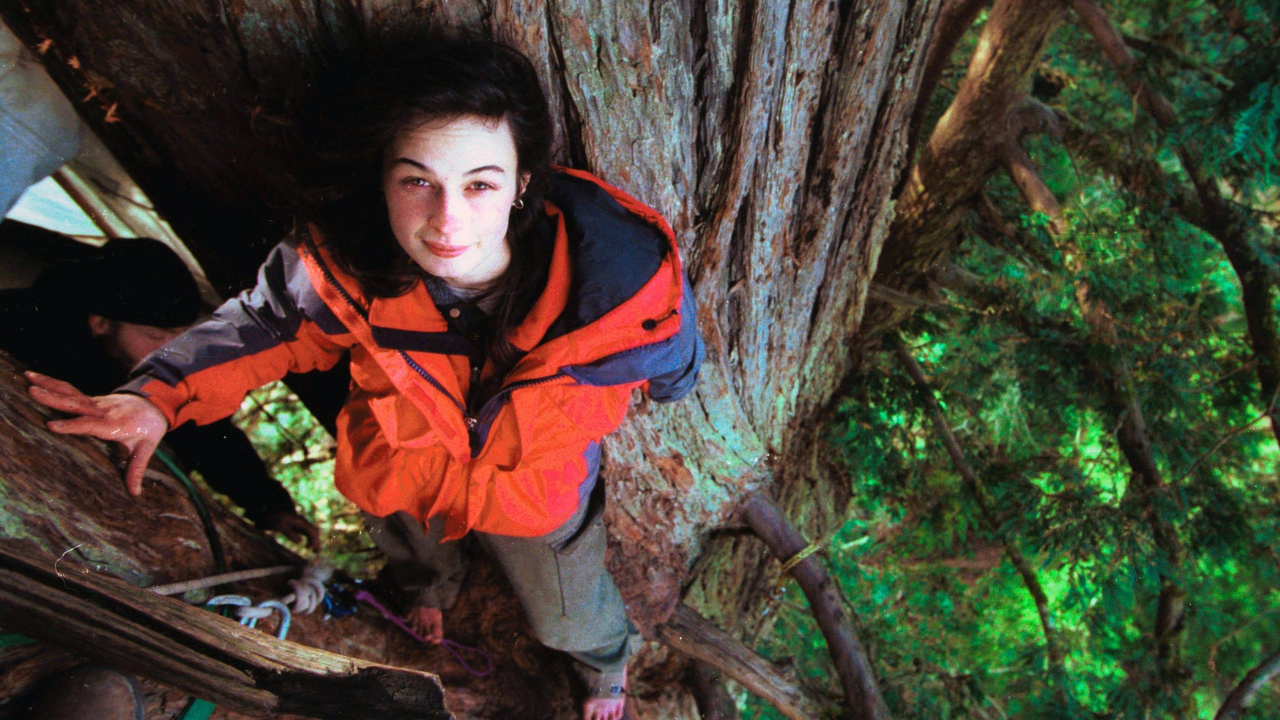
We like to paint heroes in soft, romantic pastels. The story of Julia Butterfly Hill is usually told as a fairy tale: a whimsical 23-year-old girl climbs a giant tree named Luna, makes friends with the birds, and politely convinces a logging company to leave the ancient forest alone.
It didn't happen that way. Not even close.
The real story of Julia Butterfly Hill and her 738-day tree-sit is a brutal, cold, and physically punishing battle of wills. It was waged 180 feet in the air, on a shaky wooden platform the size of a queen-sized bed, in the middle of a historic El Niño winter. It involved helicopter harassment, food blockades, and a corporation willing to let a young woman freeze to death. It wasn't about a sweet love for nature. It was about raw survival and a furious refusal to back down.
The Mudslide That Changed Everything
Most write-ups gloss over how Hill ended up in Humboldt County, California in late 1997. They make it sound like she was a lifelong radical environmentalist. She wasn't.
She grew up on the road. Her father was an itinerant evangelical minister, and her family lived out of a camper until she was ten. She was a self-described introvert obsessed with career success and material things.
Then, in 1996, a drunk driver smashed into her car. The steering wheel pushed her right eye back into her skull, and she suffered brain damage that required a year of intensive speech and physical therapy. That wreck shattered her worldview. She realized she was wasting her life on trivialities. Once she could walk and talk again, she headed west to find something real.
She arrived in Humboldt County just after a disaster.
On New Year's Eve in 1996, a catastrophic mudslide tore down the steep slopes above the tiny town of Stafford, California. A wall of mud, giant tree stumps, and logging debris—the width of a football field—rushed down the mountain. It buried homes in up to 17 feet of debris and completely destroyed eight houses.
The cause wasn't just heavy rain. It was the clear-cut logging practices of the Pacific Lumber Company, owned by Maxxam Corporation. The company had stripped the steep hillsides bare, removing the deep root networks that held the soil in place. When the rains came, the mountain simply collapsed. Pacific Lumber refused to take responsibility.
Activists with Earth First! began organizing "tree-sits" on the remaining ridges to draw attention to the corporate negligence and stop further clear-cutting. They needed volunteers. Hill had attended an environmental fundraiser nearby and visited the ancient redwoods. She was transfixed. When organizers asked for someone to sit in a giant, lightning-struck redwood overlooking the Stafford mudslide, nobody else raised their hand.
Hill stepped forward. She thought she would be up there for maybe two or three weeks.
The Brutal Physical Reality of Living 180 Feet Up
On December 10, 1997, Hill climbed a harness up the 1,000-year-old redwood they named Luna. She did not touch the ground again until December 18, 1999.
Let's be clear about what living 180 feet in the air actually looks like.
You don't have a cabin. You have a tiny six-by-six-foot platform made of salvaged wood. Your roof and walls are blue plastic tarps lashed to the branches with nylon ropes.
When the wind blows, the tree sways in arcs of up to ten feet. It feels like a never-ending earthquake. During her first winter, Hill faced the worst El Niño storms in California history. Winds screamed at 40 miles per hour, shredding her tarps, soaking her sleeping bag, and threatening to rip her platform clean off its mounts.
To survive the freezing cold, she wrapped herself in a sleeping bag, leaving only a tiny breathing hole, and held onto the tree trunk. She was constantly wet, shivering, and bruised.
The mechanics of daily survival were grueling:
- Hygiene: Hill couldn't take a shower or wash her feet. In fact, she intentionally stopped washing the soles of her feet because the sticky, black redwood sap helped her bare skin grip the wet branches when she climbed around.
- Waste disposal: She used a simple bucket lined with a trash bag for solid waste. These bags were temporarily stored in a large, hollow cave inside Luna’s trunk before being hauled down by ground support volunteers every couple of weeks.
- Cooking: She relied on a single-burner propane stove to heat up grains, beans, and vegetables. Rainwater collected in her tarps was her only source of drinking and washing water.
- Supplies: An eight-member ground crew hiked miles through treacherous, actively logged terrain to deliver food and propane, which she would hoist up using a pulley system.
Living this way does things to your body. Your muscles atrophy because you can't walk. Your skin cracks from the constant dampness. But Hill didn't leave.
The Corporate Siege and the Battle with Pacific Lumber
Pacific Lumber didn't just ignore Hill; they tried to break her.
They deployed professional security guards to establish a ten-day blockade around the base of the tree. They wanted to starve her out. Ground support volunteers had to sneak through the dark forest, dodging searchlights and guards, to tie food bags to her rope.
When the starvation tactic failed, the company escalated. They brought in a massive, twin-rotor Chinook helicopter. The pilot hovered just above Luna’s canopy, using the intense downward wind pressure from the rotors to try and blow Hill off her platform. The rotor wash was so powerful it snapped branches, shredded her shelter, and nearly threw her to her death.
Loggers on the ground screamed threats, kept searchlights trained on her platform all night to prevent her from sleeping, and air horns blasted to drown out her thoughts.
Hill responded by using their own weapons against them. Armed with a solar-powered cell phone, she transformed her tiny platform into an international press office. She gave hundreds of phone interviews to journalists, appeared on cable television shows, and talked to politicians. She made the corporate violence happening in the remote woods of Humboldt County visible to the entire world.
You can't easily chop down a tree when the eyes of the world are watching the woman sitting in it.
The $50,000 Deal and Coming Down
On December 18, 1999, Hill climbed down from Luna.
Many critics at the time, and even some hardline environmentalists, were skeptical of the resolution. To save Luna, Hill and her supporters had to make a compromise.
She signed an agreement with Pacific Lumber. The company agreed to protect Luna and preserve all trees within a 200-foot buffer zone around her. This meant Luna would never be cut down, and her immediate ecosystem was safe.
But there was a catch. Hill and other activists had to raise $50,000 to compensate Pacific Lumber for their "lost logging revenue". Essentially, they had to buy the tree's freedom. The money was raised and paid. As part of the deal, Pacific Lumber agreed to donate that exact $50,000 to Cal Poly Humboldt (then Humboldt State University) to fund research into sustainable forestry practices.
A local non-profit, Sanctuary Forest, took over the deed to the conservation easement. They still manage the easement, legally protecting Luna and her buffer zone from any future logging threat.
What Happened After the Descent
If you think the story ends with a happy walk into the sunset, you're wrong. The tragedy of Luna wasn't over.
In November 2000, less than a year after Hill came down, a vandal hiked up the mountain with a chainsaw. They cut a massive wound halfway through Luna's trunk—a cut 32 inches deep and nearly 19 feet around. It was a malicious attempt to kill the tree Hill had given two years of her life to save.
The redwood was close to collapsing.
An extraordinary coalition of arborists, civil engineers, and activists rushed to the scene. Steve Salzman, a local civil engineer, designed a massive, custom steel bracing system to stabilize the tree against the coast's brutal winter windstorms. They used steel brackets, heavy-duty cables, and a specialized clay mixture to seal the wound and help the tree heal itself.
Amazingly, the rescue worked. Redwoods are incredibly resilient. Luna survived. Today, her crown is still green, and she continues to grow, standing as a scarred but living monument to human greed and human defense.
What Activists Can Learn from Julia Hill
Hill's protest succeeded because she didn't just scream at the opposition; she made herself impossible to ignore. If you're trying to defend a cause, stop relying on passive tactics.
Do what Hill did:
- Embrace the physical reality of your fight. Do the hard, boring, uncomfortable work that others won't.
- Build a lifeline. Hill would have died or been arrested without her eight-person ground crew. You cannot fight a massive system alone. Build your network first.
- Control the narrative. Use whatever tools you have—whether a solar-powered brick phone in 1997 or modern media today—to drag corporate overreach into the light.