Some people run away from front lines. Oleksiy Yukov walked straight toward them, looking for the bodies left behind.
When a landmine blast killed the 40-year-old volunteer on August 5, Ukraine lost one of its most relentless moral compasses. Known widely as the "collector of souls," Yukov spent more than two decades unearthing fallen soldiers and civilians—not just Ukrainians, but Russian troops too. His death during a recovery mission near the front line exposes the grim, unyielding reality of what happens after the cameras stop rolling on the battlefield.
If you want to understand the true human cost of the war, you have to look at the people who clean up its wreckage. Most reporting focuses entirely on the living, the strategy, or the hardware. Yukov focused on the dead, operating on a principle most people find uncomfortable: dignity belongs to everyone, regardless of which uniform they wore.
Who Was Oleksiy Yukov
Yukov wasn't a professional soldier by trade. Long before the full-scale Russian invasion upended European security, he worked as a martial arts and Thai boxing coach in Slovyansk, deep in the war-hit Donbas region.
His grim vocation started long before 2014. As a teenager, he searched forests and fields for the scattered remains of Soviet and German soldiers from World War II. That teenage hobby turned into a lifetime obsession with closure. When fighting broke out in Donbas in 2014, he formed the volunteer group Platsdarm.
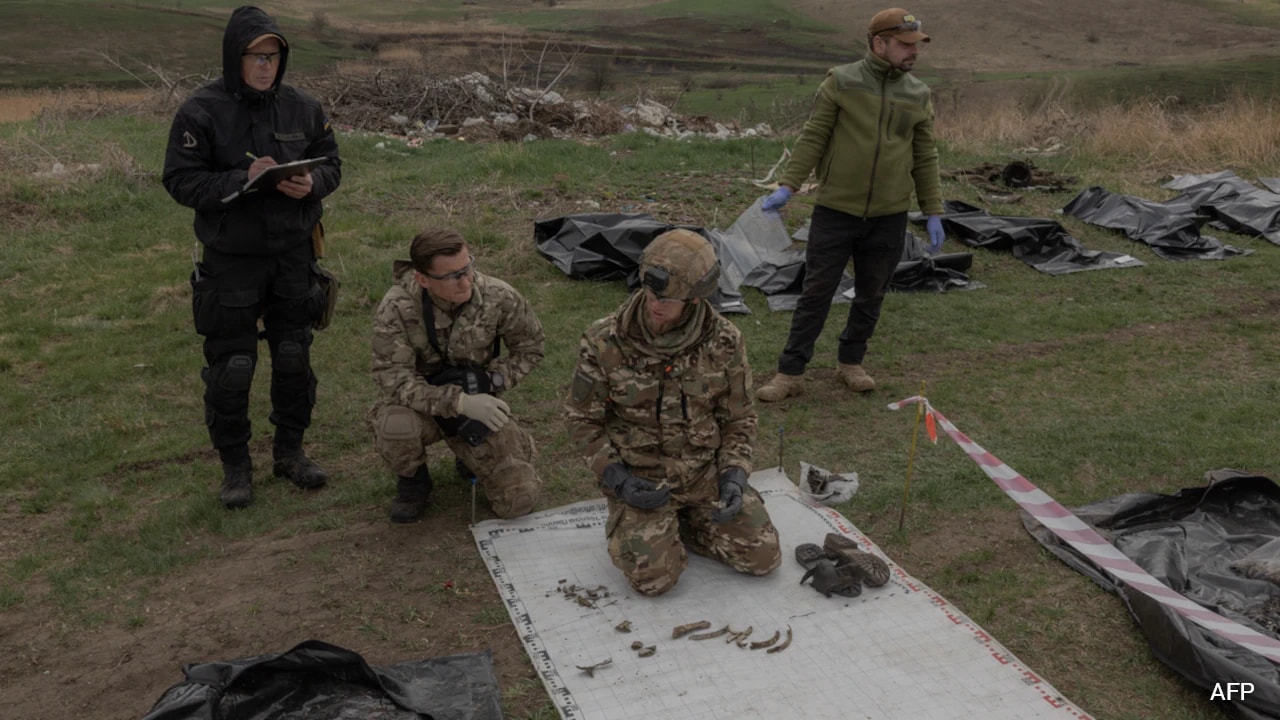
By the time the full-scale invasion hit in 2022, Platsdarm's workload exploded exponentially. Yukov and his team weren't just dealing with historical bones anymore. They were wading into active combat zones, sorting through ruined buildings, blown-out trenches, and forest belts to pull out bodies before animals or weather destroyed them completely.
The Dangers of the Body Recovery Mission
People dramatically underestimate how dangerous it is to retrieve a corpse on a modern battlefield. It isn't just about finding a body. It's about surviving the trap set around it.
By 2025 and 2026, Yukov's teams faced constant surveillance and attacks from FPV drones, remote-dropped mines, and incoming artillery. Bodies were frequently booby-trapped by retreating forces. Volunteers had to lie prone, attach long cords to corpses, pull them from a distance, and wait out agonizing ten-second windows to see if an explosive would trigger.
Yukov knew these risks intimately. In 2022, a mine blast blew out his tactical goggles, destroyed one of his eyes, and severely injured his legs. Doctors patched him up, but he didn't stay off his feet. Within weeks, he was back on crutches in the field.
"Remote mines, shelling, drones—everything is against you," Yukov wrote in a social media post shortly before his death. "But you go and do everything to ensure that every soul returns home."
Why Recovering Enemy Bodies Matters
The detail that often shocks outsiders is that Platsdarm didn't discriminate based on nationality. Yukov actively searched for, identified, and repatriated Russian soldiers.
In a conflict defined by deep-seated hatred and brutality, this stance drew criticism from some who argued enemy dead should simply be left to rot. Yukov rejected that entirely.
"When they say: 'Let them rot,' I do not agree," he wrote. "This is how we fight for every soul."
He viewed his work in deeply spiritual terms. To him, a corpse wasn't political garbage; it was a soul waiting to go home, and a family somewhere waiting for final word. Over four years of intense, full-scale warfare, his team managed to recover more than 3,500 fallen service members.
The Legacy Left Behind
Thousands gathered at the Cathedral of Saint Volodymyr in Kyiv and in his hometown of Slovyansk to pay their respects after his death. Fellow soldiers, activists, and ordinary citizens turned out because Yukov represented a rare type of human decency in the middle of total destruction.
In a February 2026 documentary, Yukov offered a grim assessment of his own timeline. "My lifetime will not be enough to bring back every soldier from this war," he noted.
He was right. The fields and forests of eastern Ukraine remain heavily contaminated, packed with thousands of missing individuals whose families live in agonizing limbo. But the standard he set—refusing to let humanity be the first casualty of war—remains the blueprint for how a broken society attempts to heal itself.
The work continues, but the field is much darker without him.