You expect smoke. You expect water damage. You don't expect to lock eyes with a wild predator from the African grasslands while putting out a routine house fire.
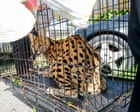
That is exactly what happened to firefighters in Marrero, a suburb of New Orleans, when they responded to a minor residential blaze. Behind the home, crammed into a makeshift 9-foot-by-9-foot enclosure that resembled a baseball batting cage, sat an African serval. No leash, no proper permit, and definitely no business being in a suburban backyard.
Jefferson protection and animal welfare services (JPaws) officials Michelle Brignac and Victoria Clark had to rush to the scene. They ended up wrestling the hissing, slender wildcat into a transport carrier before moving it to a facility in nearby Harvey.
It sounds like an outlier story. It isn't. Across North America, keeping exotic cats as pets has quietly turned into an alarming trend, fueled largely by viral social media content. People see sleek coats, towering ears, and impressive jumps online, and they forget one minor detail: these are wild animals, not oversized tabbies.
Servals are native to sub-Saharan Africa. In the wild, they roam wide grasslands, hunt diverse prey, and use their legendary vertical leap—up to seven feet in the air—to catch birds and small mammals. Putting one in a cramped chain-link cage in Louisiana isn't just cruel; it's a disaster waiting to happen.
Why do people keep trying to domesticate them?
Part of the problem is that servals share superficial traits with house cats. They purr, they groom themselves, and they yowl. Uninformed buyers assume that makes them manageable. It doesn't.
As servals mature, their wild instincts kick in hard. They mark territory aggressively, tear through drywall, shatter furniture, and cannot be fully house-trained. More importantly, they suffer from chronic stress when confined to domestic spaces that lack proper physical space and stimulation. They need specialized diets and rigorous care that standard pet owners simply cannot provide.
Local laws usually require specific exotic animal permits for a reason. In this Louisiana case, the homeowner lacked the proper documentation entirely. When JPaws officials took custody of the animal, they had to give it an entire room to itself while searching for an appropriate sanctuary, since local institutions like the Audubon zoo weren't equipped to take it on.
This Louisiana incident fits into a messy pattern across the continent.
In Ohio back in 2023, authorities captured an African serval named Amiry after it hung out in a neighborhood tree—and yes, it subsequently tested positive for cocaine. In late 2025, a search for an escaped serval in Pennsylvania ended in tragedy when a motorist struck and killed the animal. Meanwhile, authorities in Vancouver returned a stray serval to its owners just as British Columbia moved to ban exotic cats entirely, giving owners a grace period to secure permits before 2027.
Social media algorithms reward shock value. Cute videos of exotic pets rack up millions of views, hiding the reality of illegal wildlife trafficking and neglected animals. When the novelty wears off, or when the cat grows strong enough to break through doors, animal control officers and firefighters are the ones left picking up the pieces.
If you love wildlife, respect its boundaries. Leave African servals on the savanna, and leave exotic pet trends where they belong—in the past.



