Ask anyone where the United States truly began, and you'll get the same standard textbook answers. They'll tell you about the Pilgrims landing at Plymouth Rock. They'll point to Jamestown. If they're feeling patriotic, they'll point directly to Philadelphia, where the Founding Fathers signed the Declaration of Independence.
But they're missing the real story.
Long before William Penn ever envisioned his green country town, a completely different European power laid the foundation for what we now call American culture. It wasn't the British. It wasn't the Dutch. It was a tiny, overlooked, under-the-radar settlement called New Sweden.
If you want to understand the origin of the rugged, self-sufficient frontier spirit that defines the American identity, you have to look at a forgotten strip of riverfront along the Delaware Valley. This is where the American ideology actually started, and it looks nothing like the puritanical, war-torn history we've been sold.
The Secret Colony Hidden in Plain Sight
Back in 1638, the Swedish Empire was a dominant military force in Europe, but it lacked a foothold in the lucrative New World tobacco and beaver trade. Enter Peter Minuit. He was the former governor of New Netherland who had been dismissed by the Dutch. Seeking revenge and profit, Minuit approached the Swedish Crown with a map and a proposition: there was a massive stretch of land between English Virginia and Dutch Manhattan that no European power had actually occupied.
The Swedes took the bait. They didn't show up with loud, flag-planting bravado like the Spanish or French. Instead, they launched a covert corporate venture designed to slip right under the Dutch radar.
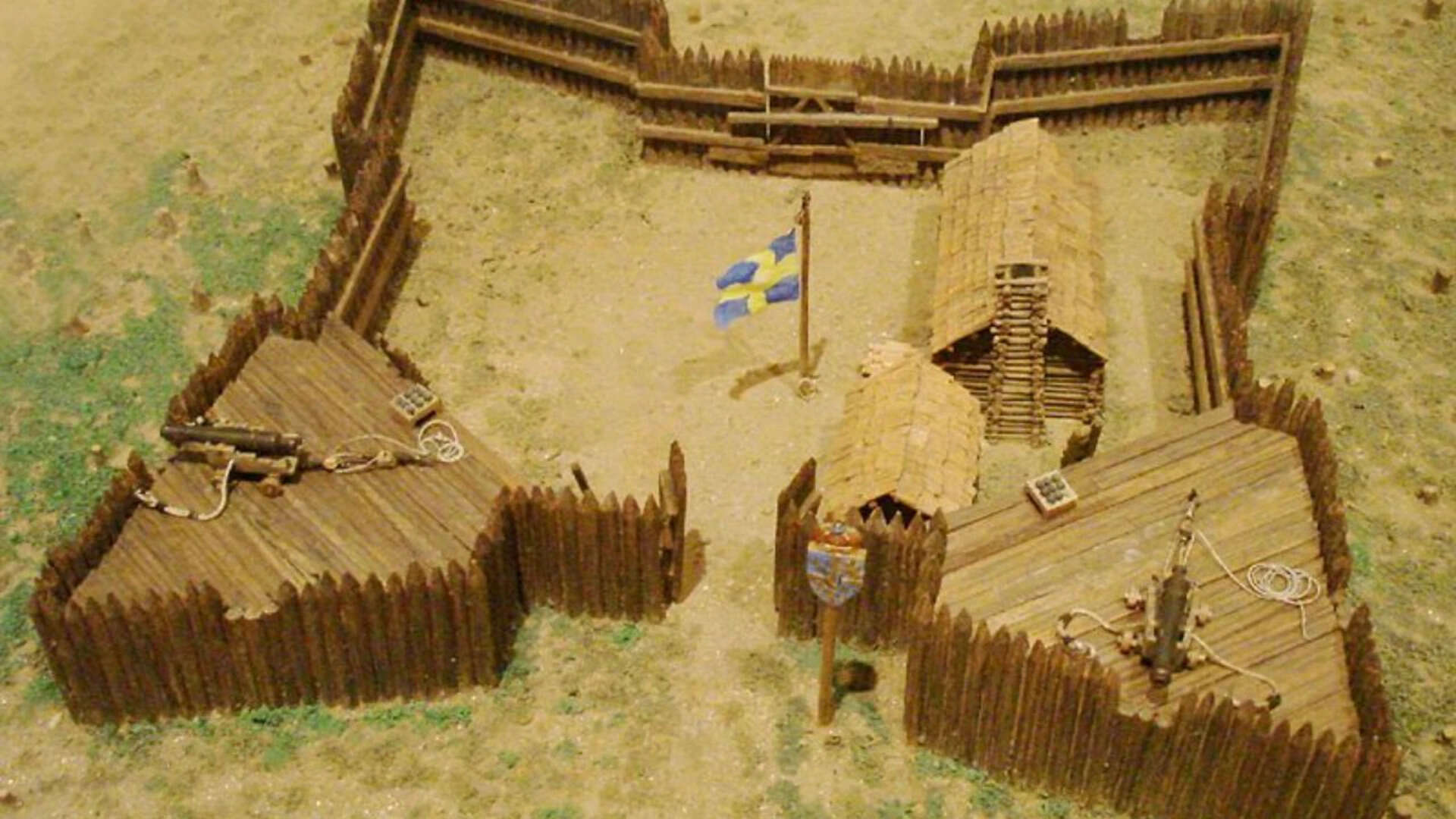
In the spring of 1638, two ships—the Kalmar Nyckel and the Fogel Grip—anchored at a rocky ledge on the Christina River, in what is now Wilmington, Delaware. Minuit bought a 67-mile stretch of land from five Native American tribes, built a small stronghold, and named it Fort Christina after Sweden’s 12-year-old monarch, Queen Christina.
At its peak, New Sweden was tiny. It never held more than about 400 people. It was the shortest-lived European colony in North America, lasting a mere 17 years before the Dutch finally noticed and absorbed it in 1655. Yet, despite its brief lifespan and minuscule population, its DNA mutated into the very backbone of American culture.
How Forest Finns Invented the American Frontier
We tend to associate the early American frontier with English culture, but the British were terrible foresters. When English Puritans arrived in New England, they tried to build traditional British frame houses. These required sawmills, bricks, mortar, nails, and massive amounts of time—luxuries the wilderness didn't provide.
The settlers of New Sweden were different. While the colony was Swedish, a huge chunk of the population consisted of "Forest Finns"—immigrants from the heavily wooded borderlands of the Swedish Empire who were masters of wilderness survival.
They brought a unique architectural technology with them: the log cabin.
To build a traditional Finnish log home, you don't need nails, spikes, bricks, or complex tools. All you need is an axe. You fell some trees, notch the ends, stack them horizontally, and jam mud or clay into the gaps. Two skilled men could throw up a tight, windproof, completely functional home in a single day.
When later waves of German, Scots-Irish, and English settlers flooded into the Delaware Valley, they looked at these Swedish cabins and realized they were looking at the ultimate survival hack. They abandoned their own inefficient building styles and copied the Swedes.
The log cabin became the universal symbol of American self-reliance, the home of Abraham Lincoln, and the quintessential marker of the Western pioneer. But it wasn't born in Kentucky or Illinois. It was imported from the Scandinavian woods to the banks of the Delaware.
The Only Colony That Chose Peace
The dominant narrative of early America is one of constant, bloody warfare between European colonizers and Indigenous tribes. Jamestown had its brutal conflicts; New England had the devastating King Philip’s War.
New Sweden was the sole exception. It was the only European colony in America that never went to war with the native population.
When Peter Minuit died in a Caribbean hurricane just five months after founding the colony, the remaining 25 settlers were left broke, isolated, and starving. They didn't survive by conquering; they survived by adapting. The Swedes and Finns treated the local Lenape and Susquehannock tribes as equals and crucial trading partners.
They learned Indigenous languages, respected tribal borders, and traded fairly for furs. The Lenape even nicknamed the colony’s infamous, 400-pound governor, Johan Printz, "Big Belly"—a testament to the familiar, if colorful, relationship between the two groups. This blueprint of peaceful coexistence and mutual respect created a localized culture of tolerance that predated William Penn’s famous "Holy Experiment" by decades.
The First Successful Political Protest in America
American democracy didn't magically materialize in 1776 at Independence Hall. Its roots were growing over a century earlier in the tiny settlements of New Sweden.
Governor Johan Printz ruled the colony with an iron fist from 1643 to 1653. He was a massive, tyrannical man who treated the free settlers like feudal peasants. The Swedish Crown completely ignored the colony during the latter half of his reign, failing to send a single supply ship between 1648 and 1654.
Fed up with the abuse and neglect, a quarter of the colony's male population did something radical in 1653: they signed a formal petition accusing Printz of abusing his powers and demanding reforms.
Printz was furious. He called it a mutiny and executed the leader. But the damage was done. The community’s collective defiance broke his spirit, and Printz packed his bags and sailed back to Sweden later that year. It stands as one of the very first successful grassroots political protests against authoritarian rule in American history.
Even when the Dutch military finally captured New Sweden in 1655, the local culture refused to die. The Dutch governor, Peter Stuyvesant, recognized that the settlers were too resilient to break, so he allowed them to continue living as a semi-autonomous "Swedish Nation". They kept their land, spoke their language, chose their own local magistrates, and maintained their own militia. They chose community over empire.
The Ghost in the Declaration of Independence
If you still think New Sweden is just a historical footnote with no connection to the founding of the republic, look at the roster of men who signed the Declaration of Independence.
In July 1776, the Continental Congress was deadlocked on the vote to split from Great Britain. The Pennsylvania delegation was split down the middle. The deciding vote fell to a modest politician from Ridley Township named John Morton.
Morton wasn't of English descent. He was the great-grandson of Morten Mortenson, an original Finnish settler who had arrived in New Sweden aboard the ship Örn in 1654.
When John Morton cast his historic vote in favor of independence, he wasn't just voting for a new nation. He was fulfilling a legacy of independence and self-determination that his Scandinavian ancestors had planted in the Delaware soil more than a century earlier.
Go See It for Yourself
Most of New Sweden has been paved over by modern industrial infrastructure, but the physical remnants of this lost empire are still hiding in plain sight if you know where to look.
- The Lower Swedish Cabin (Drexel Hill, PA): Tucked away along Darby Creek, this log structure dates back to roughly 1640. It's one of the oldest surviving log cabins in the entire Western Hemisphere and offers a direct, unvarnished look at how the Forest Finns actually lived.
- Holy Trinity "Old Swedes" Church (Wilmington, DE): Built in 1698 by the descendants of the original Swedish colonists, this is the oldest Lutheran church in America still standing in its original state.
- The Governor Printz Park (Essington, PA): This waterfront park preserves the foundations of Printzhof, the two-story log mansion built by Governor Johan Printz.
Stop thinking of early America as a purely British enterprise. The next time you take a road trip through the Mid-Atlantic, bypass the crowded lines at Independence Hall for an afternoon. Drive down to the Delaware riverfront, stand on the rocks where the Kalmar Nyckel landed, and look at the real, forgotten birthplace of the American pioneer.