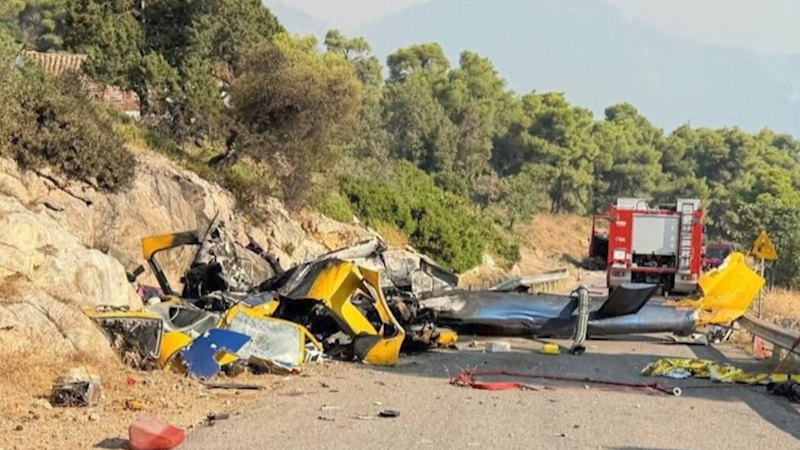
Two people are dead after a mid-air collision involving two firefighting helicopters working a massive wildfire west of Athens. The accident occurred near Psatha and Porto Germeno, laying bare the immense dangers faced by aerial crews operating in thick smoke, severe winds, and chaotic tactical environments.
The aircraft involved were Bell 214ST helicopters leased from Australian operator McDermott Aviation, a company that has spent the last seven years supplying heavy-lift assets to support Greek firefighting efforts. A Danish pilot and a Greek fire service liaison officer lost their lives in the crash, while the two-person crew of the second helicopter—consisting of a British pilot and a Greek liaison—survived with medical care.
The Reality of Low-Altitude Aerial Firefighting
Flying a heavy helicopter into a smoke-choked valley while high-velocity northerly winds fan erratic flames is a nightmare scenario. People often look at aerial firefighting through the romanticized lens of spectacular water drops captured on social media. They don't see the claustrophobic visibility limits, the violent thermal updrafts, or the congested airspace where multiple units converge on the exact same drop zone.
When a wildfire scales a mountain overnight and threatens hundreds of homes, the margin for error shrinks to zero. Coordination relies on split-second visual cues, radio traffic that can easily become overloaded, and sheer pilot skill. Initial operational assessments pointed toward the extreme tactical density and low-altitude convergence as compounding factors in the tragedy, though formal investigations by aviation authorities remain ongoing.
Global Fleets Under Unprecedented Strain
Greece has endured a punishing summer characterized by persistent heatwaves and severe dry spells, culminating in hundreds of agricultural and forest fires breaking out across the country. To manage these crises, Mediterranean nations routinely rely on international private contractors like McDermott Aviation to supplement local civil protection fleets.
These specialized heavy-lift assets log punishing hours. Crews operate on razor-thin margins of fatigue and mechanical wear. When multiple agencies and private contractors share constrained airspace over a rapidly moving front, systemic vulnerabilities multiply. This tragedy underscores a broader global reality: as climate pressures intensify wildfire seasons worldwide—forcing countries like Australia to send emergency air support to France and North America while leasing units to Europe—the infrastructure supporting international firefighting is stretched to its absolute limit.
Looking Forward at Aviation Safety Standards
Preventing future tragedies requires a hard look at how tactical airspace is managed during peak emergency response. Standardizing proximity warning tech, improving formation communication protocols for mixed international crews, and establishing mandatory crew rest limits during sustained multi-day heatwave spikes are critical steps.
Greek Prime Minister Kyriakos Mitsotakis expressed profound grief over the loss of the frontline personnel, echoing the sorrow of communities whose homes and lives hang in the balance during these disasters. Honor the reality of the skies by recognizing that every water drop comes with an extraordinary human toll.
Two killed in Greece after Australian firefighting helicopters collide | 9 News Australia
This broadcast segment provides on-the-ground news coverage and details regarding the tragic mid-air collision of the firefighting helicopters near Athens.
http://googleusercontent.com/youtube_content/1