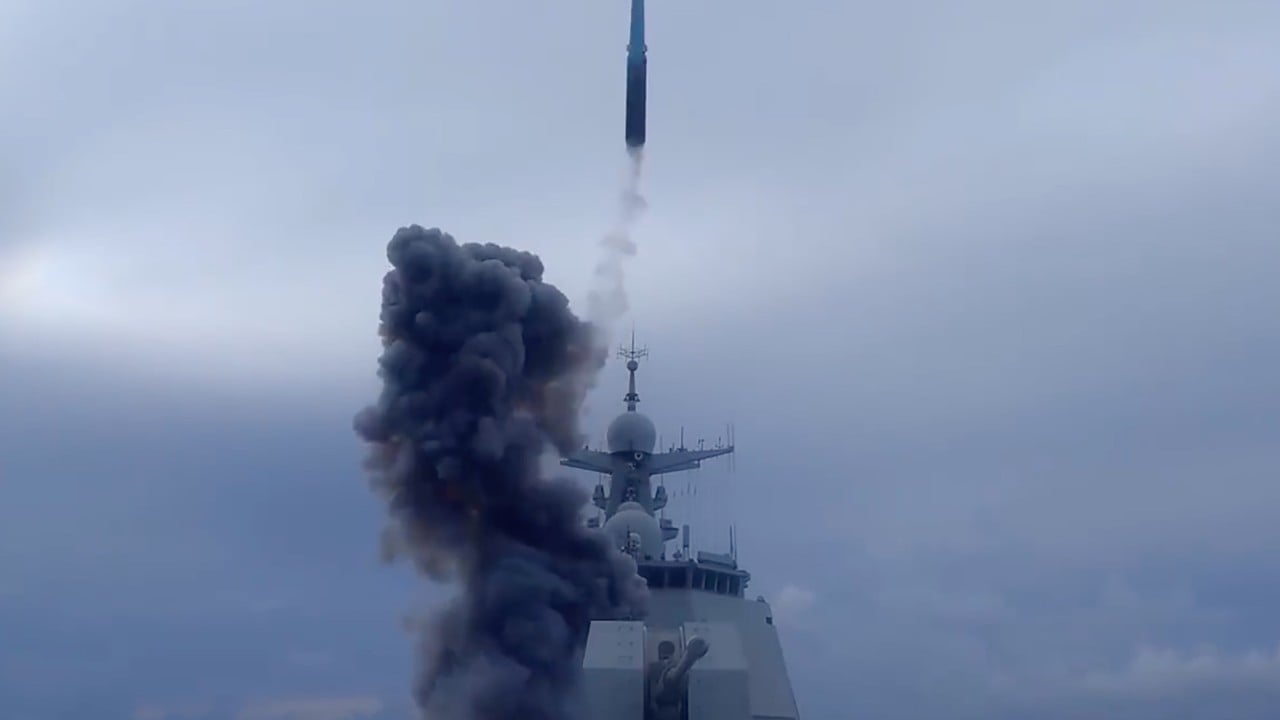
Military planners in Washington are staring at a very uncomfortable reality. If a conflict breaks out over Taiwan, the traditional American playbook of sailing nuclear-powered supercarriers right up to the Chinese coastline won't just be dangerous—it might be suicidal.
At the center of this shifting tactical balance are Beijing's advanced hypersonic anti-ship missiles, frequently dubbed carrier killers. These weapons aren't just theoretical hardware paraded around for domestic propaganda. They represent a fundamental restructuring of modern naval warfare, specifically engineered to neutralize America's primary projection of power in the Indo-Pacific.
The Hypersonic Advantage
Standard anti-ship missiles travel at subsonic or low supersonic speeds. While dangerous, naval defense networks equipped with advanced radar, electronic jamming, and multi-layered interceptor missiles can track and shoot them down given enough reaction time.
Hypersonic weapons completely break this math. Traveling at speeds exceeding Mach 5—and often maneuvering unpredictably during flight—missiles like China's YJ-21 or newly deployed variants shorten interception windows from minutes to mere seconds.
Radar systems get overwhelmed. Combat information centers don't have enough processing time to compute firing solutions. Even if an interceptor missile manages to get launched, the kinetic energy and extreme velocity of a hypersonic warhead mean that a near-miss can still cause catastrophic structural damage to a multi-billion-dollar warship.
Shifting the Strategic Distraction
The core utility of these weapons isn't just sinking ships. It's about psychological and operational coercion.
In any prospective cross-strait crisis, the United States Navy would face a brutal dilemma. Rush carriers into the First Island Chain to support Taiwan, and risk losing irreplaceable naval assets within the opening hours of a shooting war. Stay back beyond the reach of coastal batteries and hypersonic strike groups, and watch your regional allies lose confidence in your security umbrella.
Beijing has designed these systems to create an anti-access/area-denial zone. By forcing American carrier strike groups to operate thousands of miles away—out of effective aircraft combat radius—the missiles achieve their primary goal without even being fired. They act as a massive spatial tax on the US military, demanding vast resources, constant intelligence tracking, and defensive posture adjustments just to survive.
The Logistics and Attrition Trap
Defense analysts often obsess over the hardware, but the real crisis is industrial capacity. Building a Ford-class carrier costs around $13 billion and takes years of specialized shipyard labor. Meanwhile, mass-producing intermediate-range ballistic and hypersonic missiles is far cheaper and faster.
If a conflict turns into a war of attrition, the side with deep manufacturing redundancy wins. Recent internal Pentagon wargames and leakage reports underscore a sobering truth: current US stockpiles of high-altitude interceptors and precision munitions would deplete rapidly under sustained engagement.
What Comes Next
Washington is scrambling to adapt. The Pentagon is investing heavily in distributed maritime operations, unmanned surface vessels, and long-range counter-strike capabilities to dilute the concentration of risk currently centered on large aircraft carriers.
Yet, closing the hypersonic gap won't happen overnight. Until the US fields reliable defense mechanisms against maneuverable high-speed threats, Beijing's carrier killers will remain the ultimate wildcard in any showdown over Taiwan.