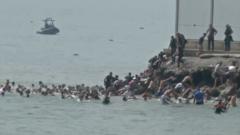
Thousands of people are actively streaming into Europe's only land border with Africa. They aren't waiting in lines or filling out paperwork. Instead, they are stripping down, grabbing inflatable rings, and plunging straight into the Mediterranean Sea.
If you've watched the footage coming out of Ceuta, you know it looks like total chaos. People are swimming around the massive border breakwaters, scaling fences, and running onto Spanish soil shouting for joy. Local authorities are overwhelmed. Reception centers are packed beyond capacity. The central government in Madrid has faced immense pressure, eventually deploying the military to restore order at the frontier.
Behind these dramatic swimming clips lies a complex geopolitical pressure cooker. Let's break down what is actually driving this recurring migrant surge in the Spanish enclave of Ceuta.
The Geography of Desperation
Ceuta is a tiny Spanish territory tucked onto the northern coast of Africa. It shares a direct border with Morocco. Because it belongs to Spain, it belongs to the European Union.
That single fact makes it a magnet.
For young men and families fleeing economic dead ends or hardship in Morocco and other parts of Africa, Ceuta represents a shortcut to Europe. You don't need a smuggler's boat for a treacherous multi-day voyage across the open ocean to the Spanish mainland. You just need to get past the physical barriers separating Fnideq, Morocco, from Spanish ground.
Sometimes that means scaling the towering multi-layered border fences. Other times, when security forces are stretched thin or surveillance gaps open up, it means swimming around the coastal breakwater at Tarajal.
Why Do Swimmers Change the Equation?
The mode of entry matters deeply under Spanish law. When individuals try to jump over the land border fence, authorities can often enact swift pushbacks under specific border rules.
However, legal frameworks shift when people arrive by sea. A recent Spanish Supreme Court ruling established that migrants arriving via maritime routes cannot be summarily turned away without individual due process. Local leaders in Ceuta pointed directly to this legal distinction as a catalyst for the surge. Whether every swimmer understands the nuance of Supreme Court jurisprudence is doubtful, but word travels fast through border towns. Once rumors spread that sea arrivals have a slightly better chance of processing rather than instant expulsion, the beaches fill up.
The Diplomatic Lever
Migration at Ceuta is never just about local policing. It is a barometer for diplomatic relations between Spain and Morocco.
Controlling this frontier relies heavily on Moroccan cooperation. Morocco guards its side of the fence. When Rabat wants to apply pressure on Madrid over foreign policy disputes—such as regional sovereignty or diplomatic stances—the enforcement at the border tends to loosen.
We saw this playbook in full effect during the massive 2021 crisis when thousands entered over a couple of days. While current updates indicate Moroccan police are stepping up efforts to intercept people on their side, managing thousands of desperate individuals spread across rocky coastlines is an immense logistical nightmare.
What Happens Next on the Ground?
The human cost of these crossings is tragic. Local officials and rescue workers report fatalities in the water as strong currents and exhaustion claim lives during the rush.
For the people who make it across, the immediate future involves sleeping outdoors near saturated reception centers or waiting for emergency processing. For Spain's political leadership, the crisis forces a difficult balancing act between humanitarian obligations, legal mandates, and national security.
The border fence keeps expanding. The surveillance cameras keep rolling. Yet as long as the economic disparity across the Strait of Gibraltar remains wide, people will keep looking at the water and taking their chances.
Desperate Journey: Migrants Swim for Hours to Reach Spain's Ceuta as Border Crisis Deepens
This video provides on-the-ground footage and context regarding the recent surge of migrants swimming across the sea to reach the Spanish enclave of Ceuta.
http://googleusercontent.com/youtube_content/1


