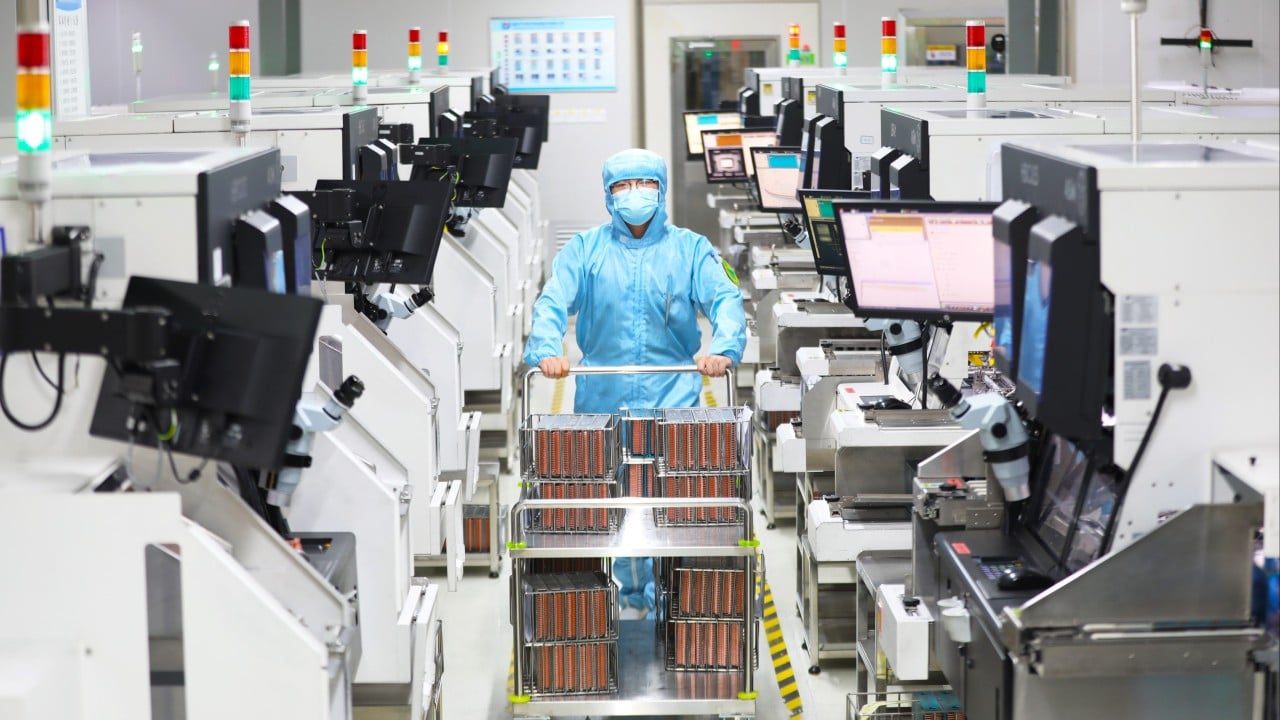
Beijing isn't waiting around for Washington to lift export restrictions. Instead, policymakers have laid out a massive economic blueprint for 2026 through 2030 that treats domestic chipmaking and artificial intelligence as questions of ultimate national survival.
When the Ministry of Industry and Information Technology along with the National Development and Reform Commission released their latest electronic information manufacturing road map, the message was loud and clear. China wants a complete structural overhaul of its domestic technology stack. Rather than chasing isolated patches or quick fixes, the plan targets the entire semiconductor supply chain from design tools to high-end manufacturing. Don't miss our earlier coverage on this related article.
If you look at the raw numbers, the scale is staggering. Officials have set a target for enterprises above designated size to exceed 30 trillion yuan, roughly 4.5 trillion dollars, in total operating revenue by 2030. Achieving that means adding about 10 trillion yuan in revenue over the next five years. R&D intensity is slated to hit 3.5 percent across the board.
Why the Old Playbook Failed
For years, domestic firms tried to piece together components from foreign vendors while slowly building up local alternatives. That piecemeal approach hit a brick wall when Western export controls tightened. Restrictions from bodies like the US Bureau of Industry and Security increasingly targeted advanced processors and equipment shipped to any entity with Chinese parentage, regardless of physical location. To read more about the background of this, MIT Technology Review offers an informative breakdown.
That squeeze changed the calculus in Beijing. Leaders realized that a fragile supply chain means vulnerability. The new strategy focuses squarely on eliminating choke points. The roadmap explicitly outlines 17 key tasks, with full-chain semiconductor breakthroughs sitting at the very top of the priority list.
You can't build a 30 trillion yuan industry on shaky foundations. That is why the blueprint covers every single segment of integrated circuits: design, fabrication, packaging, testing, core materials, and electronic design automation software.
Beyond Traditional Chips
It's not just about replicating legacy silicon. The roadmap pushes hard into advanced architectures, high-density memory, and ultra-wide-bandgap materials like gallium oxide. At the same time, policymakers are aggressively funding next-generation computing paradigms.
In-memory computing, quantum systems, and space-based architectures are getting serious attention. The goal is to back massive artificial intelligence clusters capable of running hundreds of thousands of specialized chips simultaneously. By treating AI as a triple threat—a driver of productivity, an instrument of sovereignty, and a military capability—Beijing is coordinating policy across every single layer of the stack.
The Global Ripple Effects
While the United States relies heavily on private venture capital and major corporate spenders to drive innovation, China's state-directed approach operates differently. The protected domestic market allows local platforms to accumulate massive user bases and data streams that fund continuous model training. Meanwhile, open-weight models originating from the region compete aggressively on price and accessibility across international markets.
This dual-track approach creates a formidable challenge for Washington's containment strategy. While American policymakers attempt to rally allies around strict export controls and technological decoupling, the sheer momentum of a state-backed supply chain gives domestic firms a massive captive market to test, refine, and scale their technologies.
You are watching a complete restructuring of global tech supply chains in real time. The outcome won't be decided by a single breakthrough or a temporary trade truce. It hinges on who can build a resilient, self-sustaining ecosystem that survives pressure from adversaries and scales faster than the competition.