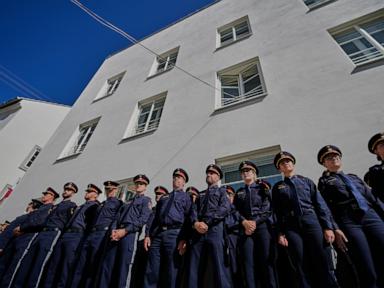
Walk down Salzburger Vorstadt in the quiet border town of Braunau am Inn, and you might walk right past number 15 without a second glance. The three-story building has crisp white walls, freshly painted window frames, and a simple blue and white sign by the front door that reads "Polizei."
It looks like any municipal station in Western Austria. That’s the point.
For decades, this 17th-century structure was the most uncomfortable piece of real estate in Europe. Adolf Hitler was born in a rented room on the top floor on April 20, 1889. He only lived there for a few weeks before his family packed up and moved, but that brief stay cast a long shadow over the town. Neo-Nazis kept showing up. Fans of the Third Reich traveled from across the globe to pose for quick photos, leave flowers, or make silent gestures on the sidewalk.
Austria wanted the spectacle to end. On July 22, 2026, after a 20-million-euro redesign that ran three years behind schedule, the Austrian government formally opened the building as an active police station and human rights training center.
The government calls it a victory for democracy. Critics call it a expensive attempt to whitewash history. Both sides have a point, and the story of how this house became a police station says a lot about how Europe wrestles with its darkest memories.
A Quiet Town and a Very Loud Problem
To understand why Austria spent millions stripping a building of its character, you have to realize how troublesome the site was for Braunau am Inn.
Hitler’s family was barely there. His father, Alois Hitler, worked as a customs official on the Austro-German border. The family rented space in the Gasthof zum Pommer, an inn with apartments above a local brewery. Within a month, they moved to another address in town, and by the time Hitler turned three, they had left Braunau altogether.
The town never got to move on.
When Nazi Germany annexed Austria in the 1938 Anschluss, the regime bought the building and turned it into a cultural center and art gallery dedicated to the Fuhrer's birth. After World War II, American troops temporarily used it to host a historical exhibition on concentration camp atrocities. Eventually, the property returned to its pre-war private owners, the Pommer family.
For forty years starting in 1972, the Austrian Interior Ministry rented the building from the Pommers. They didn't rent it because they needed the space. They rented it to keep control over who went inside.
For a long time, the state sublet the space to Lebenshilfe, a charity supporting people with intellectual disabilities. That was a poetic twist. The regime that systematically murdered disabled individuals under its euthanasia programs was having its founder's birthplace used to empower them.
Then everything ground to a halt in 2011.
The Decade-Long Legal Battle With Gerlinde Pommer
The house started falling into disrepair because the owner, Gerlinde Pommer, refused to allow any major renovations. She wouldn't let the government install wheelchair ramps, repair aging utilities, or modify the facade.
Lebenshilfe had to move out because the building no longer met accessibility standards. For five years, the yellow structure stood empty. The state kept paying roughly 5,000 euros a month in rent for a ghost building just to keep extremists from buying or leasing it.
Pommer turned down every purchase offer from the Austrian government. She rejected plans to turn it into a museum or a center for historical reflection.
By 2016, Parliament had enough. Lawmakers passed a special law allowing the state to expropriate the property. Pommer sued, taking her case all the way to Austria’s Supreme Court. She argued the seizure was unconstitutional and demanded higher compensation.
In 2019, the court ruled in favor of the state, awarding Pommer roughly 810,000 euros. Austria finally owned the house, but owning it created a whole new headache: what do you actually do with Hitler's birthplace?
Three Ways to Deal With a Dark Landmark
When a state inherits a site tied to a dictator, it usually considers three options.
Option 1: Tear it down
Demolition sounds clean. Knock it to the ground, sow seeds, and make a public park.
Austria quickly ruled this out. Historians warned that razing the house would look like an attempt to erase history. Critics abroad would argue Austria was trying to sweep its Nazi past under the rug. Besides, tearing down a building doesn't destroy the location. Neo-Nazis would simply gather at the empty lot instead.
Option 2: Build a Holocaust memorial or museum
You could turn it into a museum dedicated to the victims of National Socialism.
An expert commission set up by the Interior Ministry vetoed this idea. They worried that any public museum or educational center at Hitler's birth site would inevitably become a focal point. Extremists would still make the trip. Even if the museum condemned Nazism, neo-Nazis would stand outside to soak in the geography. The commission wanted to destroy the attraction, not curate it.
Option 3: Neutralize it through administrative use
This was the winning strategy. The goal was simple: strip the building of any historical weight or "mystique."
By handing the keys to the district police headquarters, the government put state power and law enforcement directly inside the structure. Nothing deters far-right extremists from hanging around a building quite like dozens of armed police officers walking in and out of the front door all day.
The 20-Million-Euro Facelift
Austrian architecture firm Marte Marte won the design competition to overhaul the building. Their mandate wasn't to preserve the past—it was to erase its visual signature.
Before the transformation, the house featured traditional 17th-century roughcast yellow plaster walls, historic window frames, and gables that looked straight out of a postcard.
Architects stripped away those elements. They whitewashed the facade, leveled out historic rooflines, and added modern, minimalist extensions to the rear of the complex.
Inside, the building looks like a standard station. It features holding cells, interrogation rooms, administrative desks, and a dedicated training floor.
Starting in late 2026, the building will serve as a specialized center providing human rights training for police officers from across Austria. Interior Minister Gerhard Karner put it plainly at the opening ceremony: "This house will now become a place of democracy, rule of law, security, freedom, and human dignity."
There is no plaque on the wall mentioning Adolf Hitler. There is no historical exhibition inside. The only sign on the front of the building says "Polizei."
The Memorial Stone That Survived the Renovation
While the building itself lost its historical look, one important piece of the past stayed put on the sidewalk outside.
In 1989, a hundred years after Hitler was born, the mayor of Braunau placed a heavy granite block on the pavement directly in front of the house. The stone came from the quarry at the nearby Mauthausen concentration camp, where tens of thousands of prisoners were worked to death by the Nazi regime.
The inscription carved into the granite reads:
For Peace, Freedom, and Democracy. Never Again Fascism. Millions of Dead Warn.
Notice anything missing? The text never mentions Adolf Hitler by name.
When the government announced its plan to turn the house into a police station, the expert commission recommended removing the memorial stone. They felt leaving the rock outside would undermine the "neutralization" of the site.
The local town council refused. They insisted the stone stay where it was. Today, that slab of Mauthausen granite remains on the pavement, serving as the sole visible reminder of the atrocities connected to the man who was born upstairs.
Why Most Austrians Weren't On Board
If you think this project had unanimous support across Austria, think again.
When the government surveyed the Austrian public during the planning phase, only 6% of respondents favored turning the building into an administrative or government office.
The breakdown was clear:
- 53% wanted the house turned into an educational institution dedicated to anti-fascism, tolerance, and peace.
- 20% wanted the building completely demolished.
- 6% backed using it for state administrative purposes.
Holocaust survivor organizations expressed deep skepticism too. The Mauthausen Committee, Austria’s primary survivor advocacy group, voiced opposition to making it a police station. They argued that police forces under the Third Reich were key instruments of Nazi terror and deportation. Placing a police unit inside Hitler’s birth home without a prominent educational center felt out of touch to many survivors.
Film director Gunter Schwaiger, who made a documentary about the house, uncovered historical documents showing that Hitler himself had once expressed a desire for his birth house to be used for administrative purposes by the state. Schwaiger argued that by turning it into a government office, Austria was unintentionally fulfilling the dictator's long-lost wish.
Government officials countered that adding human rights instruction to the police headquarters flipped the narrative on its head. Instead of an organ of authoritarian rule, police officers would use the building to study constitutional rights, civil liberties, and the prevention of state abuse.
The Bigger Picture: Facing the Victim Myth
To understand why this decision was so contentious, you have to look at how Austria handled its World War II history for decades.
After 1945, the country adopted the "first victim" theory. The narrative claimed Austria was merely the first nation invaded and annexed by Nazi Germany in 1938. This allowed generations of citizens and politicians to avoid taking responsibility for the crimes of the Third Reich.
The truth was much more complicated. Hundreds of thousands of Austrians welcomed the Anschluss with open arms. Austrians were heavily overrepresented in the SS, the concentration camp guard corps, and the upper ranks of the Nazi party apparatus. Out of six major extermination camps, four were commanded by Austrians.
It wasn't until 1991 that Chancellor Franz Vranitzky gave a landmark speech officially acknowledging that Austrians were active perpetrators of Nazi crimes, not just victims.
Turning Hitler’s birthplace into a sterile police station feels to some like a return to that old impulse: if a problem is too uncomfortable, paint over it and pretend it isn't there. To others, it is the ultimate practical solution to an impossible problem.
What You Should Know If You Visit Braunau Today
If you find yourself traveling through Upper Austria, here is how to navigate a visit to Braunau am Inn thoughtfully:
- Adjust your expectations. You won't find a museum, a gift shop, or a plaque about Hitler at Salzburger Vorstadt 15. It is a functioning, secured police facility.
- Respect the local community. Braunau is a charming, medieval town with colorful squares, historic churches, and quiet riverside paths. Residents are tired of their home being treated like a dark tourism gimmick.
- Know the law. Austria enforces strict laws regarding Nazi symbols, salutes, and glorification (the Verbotsgesetz). Security cameras actively monitor the exterior of the building, and police will immediately intervene if anyone attempts inappropriate gestures or photos.
- Visit Mauthausen instead. If you want to understand the history of Nazi atrocities in Austria, skip the photo op in Braunau and take the one-hour drive to the Mauthausen Concentration Camp Memorial. That is where real history, education, and commemoration happen.
By turning number 15 into a police station, Austria made a deliberate choice: it chose utility over memory, security over education, and quiet routines over dark tourism. Time will tell whether whitewashing the walls truly neutralizes the past, but for the people of Braunau, the silence outside the front door is a welcome change.