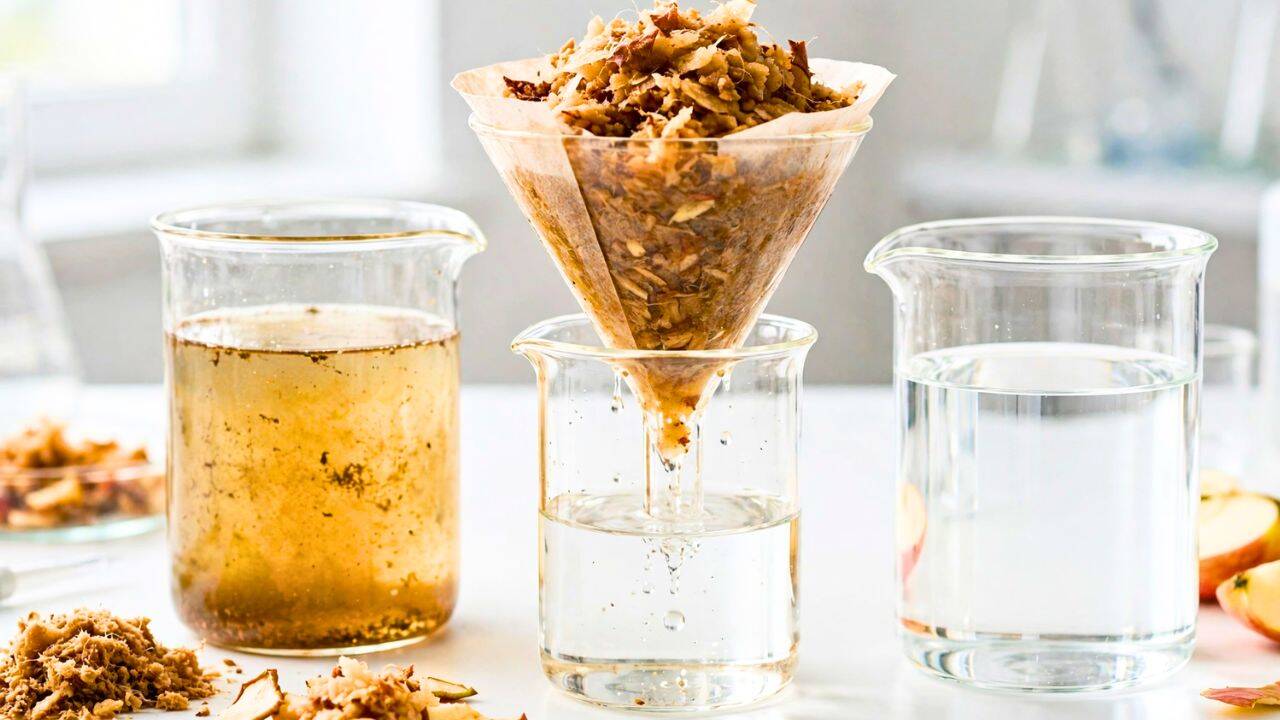
Every time juice factories press another batch of fruit, tons of mushy residue gets thrown away. Most people don't think twice about that sticky pulp rotting in landfills. But a recent study published in the journal Heliyon flips that script entirely, showing that apple waste can trap up to 100% of toxic lead from water in lab tests.
If you care about chemical filtration or zero-waste tech, this discovery changes how we look at everyday agricultural trash. Let's break down what actually happened in the lab and whether this plant-based cleanup trick holds up outside controlled experiments.
The Problem With Traditional Water Filtration
Heavy metal contamination remains a massive headache for municipal treatment plants and industrial sites. Standard filtering solutions often rely on expensive synthetic resins, activated carbon, or chemical precipitation methods that generate secondary sludge. These setups cost a fortune to install and maintain.
That is why researchers started testing agricultural byproducts like apple pomace. Instead of buying expensive manufactured chemicals to strip out heavy metals, scientists are looking at biosorption. Plant materials contain natural chemical groups that love latching onto dissolved metal ions. Apple waste happens to be packed with them.
Raw Versus Biorefined Apple Pomace
The study didn't just look at random apple peels thrown into a beaker. The research team compared two distinct materials created from juice production residue:
- Raw Apple Waste (RA): Dried, ground, and sieved directly without any chemical upgrades.
- Extracted Apple (EA): Residue that first went through a biorefining process to strip out valuable water-soluble and lipid-soluble compounds.
You might assume that stripping out those natural compounds would ruin the material's filtering capacity. Surprisingly, it did the exact opposite under optimal test conditions.
At an initial lead concentration of 20 mg/L and an optimal pH level of roughly 5, the raw apple waste removed 82% of the dissolved lead. Meanwhile, the extracted apple material hit a staggering 100% removal rate. Both variants proved that leftover fruit pulp packs serious heavy-metal-grabbing muscle.
How Fast Does It Work?
Speed matters when you are processing millions of gallons of runoff or industrial effluent. Nobody wants a filter that takes days to react.
The lab tests tracked absorption kinetics over time. The results showed a sharp drop in water lead levels almost immediately. Roughly 80% of the total maximum lead removal happened within the first sixty minutes of contact. Things slowed down between the one and two-hour marks, wrapping up around 95% total reduction during that window for the general trials.
Mathematical modeling indicated that a pseudo-second-order model fit the kinetic data best. For practical applications, this means the chemical bonding between the metal ions and the fruit surface happens rapidly and reliably.
The Chemistry Behind the Catch
Why does fruit pulp act like a heavy metal sponge? Spectroscopic analysis of the used biosorbents gave scientists a clear peek at the molecular mechanics.
When lead-contaminated water flows through the crushed apple material, functional groups on the surface—specifically hydroxyl and carbonyl groups—interact with the positively charged lead ions. Think of them as microscopic velcro hooks.
pH levels also play a massive role here. Acidic wastewater makes it harder for some materials to bind, but as the pH scaled up toward neutral levels in the experiment, more negatively charged sites opened up on the apple residue surfaces. That electrical attraction pulled the toxic lead right out of the liquid suspension.
Can You Use This at Home Right Now?
Let's be realistic. You shouldn't start drying out old apple cores in your kitchen window and dropping them into your drinking pitcher.
The research used synthetic water solutions in a controlled laboratory environment with specific mass dosages (around 0.5 g/L to 1 g/L). Scaling this up to real-world municipal water treatment or industrial factory outflows requires extensive engineering, structural pelletizing, and regulatory approvals.
Even so, the implications for circular economies are huge. Juice manufacturers produce massive streams of wet organic waste that normally cost money to haul away. Turning that liability into an organic biosorbent for wastewater treatment creates an undeniable win-win for environmental tech.
Keep an eye on industrial biosorption trials over the next few years. Your next glass of purified water might owe its safety to yesterday's cider leftovers.